2025 in review, with Sammy Cottrell


Our annual year-in-review episode covers some recurring themes from 2025 and some behind-the-curtains discussion of running a podcast. Patrick sits down with producer Sammy Cottrell to discuss the most popular episodes of the year, the impact of AI coding tools, the challenges of video podcasting, Sammy's role as a "fixer" finding guests, and much more.
Sponsor: Framer
Framer is a design and publishing platform that collapses the toolchain between wireframes and production-ready websites. Design, iterate, and publish in one workspace. Start free at framer.com/design with code COMPLEXSYSTEMS for a free month of Framer Pro.
Timestamps:
(00:00) Introduction
(01:38) The challenges of video podcasting
(02:52) AI discussions and ethical considerations
(04:29) Supporting LessWrong and LightHaven
(07:24) Adventures in AI-assisted hobbies
(12:38) Popular episodes recap
(19:45) Sponsor: Framer
(20:52) Tech companies and government relations
(24:52) Understanding credit card fraud topology
(25:57) AI data centers and power economics
(27:30) Recording logistics at Lighthaven
(32:31) The value of company podcasts
(38:03) Year in review and investigative journalism
(43:02) Creating a fantasy roguelike game with AI
(49:13) Wrap
Transcript:
Patrick: Welcome to Complex Systems, where we discuss the technical, organizational, and human factors underpinning why the world works the way it does. Hideho everybody. My name is Patrick McKenzie, better known as Patio11 on the Internet, and I'm here with Sammy Cottrell, who is the sometimes producer of this podcast.
Sammy: Heya Patrick. Good to be back.
Patrick: Good to have you back, Sammy. So it's been our tradition for the last couple of years to do a bit of a year-in-review episode, talk about things that we've talked about during the year, subjective impressions on what episodes, guests, and topics we liked, and maybe think a little bit about the coming year. [Patrick notes: Last year’s episode.]
But before that, want to give you the floor. One of the reasons I think this is important is every media property has people who work behind the scenes and often don't get the appropriate amount of recognition for their efforts. So I'd like to recognize that this podcast likely wouldn't exist without you. Tell people a little bit about what you do.
Sammy: I like to brand myself as a fixer, which often just looks like going out and solving complicated problems in the world, especially the types of problems that require meeting people that the client has not met. For this podcast that typically looks like finding guests. [Patrick notes: I source about 50% of guests; Sammy sources about 50% of guests. This is higher than my expectation prior to working with him, given e.g. relative strength of rolodex.]
A lot of the people I'm really happy that we've had on are people that I was like, wow, this person would be so great on Complex Systems. And yeah, the other main project that I did for this podcast this year was building a podcast studio at Lighthaven, which I'm really proud of and we can talk about a little bit more later.
Patrick: Well, that's as good as anything to transition into the topic on the joys and terrors of doing video podcasts.
For those of you who are listening to this, this podcast also exists on YouTube for occasional video episodes, which I pull my hair out for all the reasons. The toolchain is completely different, even though thankfully I'm not the person operating it most of the time. They're a pain in the keister to schedule for people. We do them exclusively in person and so that limits the pool of guests and typically limits it to times of the year where I have flown out to the San Francisco Bay Area.
But be that as it may, there are some people who only watch things rather than listening to them, which, to each their own. I'm more of a reader than a listener or a watcher (although my YouTube stats for this year might not agree with that). So video is an additional bite at the audience apple.
I do think there are some topics where some amount of seeing that the person is empathetic and similar adds to the experience of talking about it versus simply hearing their words. I think that came across most frequently in some of our episodes about AI where we were philosophizing. We had the Emmett Shear episode where we were talking largely about x-risk and the ethical status of AI and similar. One recurrent theme in speaking about AI is we are, minimally, very clearly in the early stages of an industrial revolution. The great majority of the world, including people in corridors of power, do not understand that yet. And those of us who do understand it—I think we have a responsibility to communicate that understanding to the rest of the world, and I think we're also sorting through our own feelings on it.
I have feelings that are obviously different than podcast guests. That's the reason for having conversations. But it's useful to be able to look someone in the eye and see when they're very clearly disturbed by the present trajectory of the technology versus watching and worried or other things that you could describe your own opinion as.
Sammy: Yeah, I think the video episodes help showcase personality in a way that sometimes audio doesn't get across in the same way.
Patrick: Oh, speaking of Lighthaven, so Lighthaven is run by Lightcone Infrastructure, which is a nonprofit. They also run LessWrong, the website that I'm sure many listeners are familiar with. As someone who has previously been a CEO of a nonprofit, nonprofit fundraising is a pain in the keister, and a particular thing that happens with many nonprofits is they do an annual fundraising drive and every year it is like literally down to the last few minutes on whether we will be able to keep our doors open for the next year. Lightcone Infrastructure is currently in the middle of its annual fundraising drive. [Patrick notes: Donation link, for your convenience.] I've donated a small amount of money to them. I think they're relevant to the interests of many people who are listening to this. If you agree that the Internet is better with LessWrong on it, you might consider donating as well.
Sammy: Or that Berkeley, California is better with Lighthaven in it, which I strongly believe.
Patrick: Lighthaven. Let's see, they were written up in the New York Times again this year, not using the exact same language as the Guardian's write-up of a "walled, surveilled compound." But I think the New York Times write-up was focusing on it being a religious commune, which—as someone who actually is religious—the times I've been to Lighthaven events, I have attended numerous religious services, Catholic masses and a Jewish dinner party on two occasions, but I cannot confirm the presence of a religious organization within the conference venue itself. Oh, the New York Times.
Sammy: Was that the article that said they don't always allow outsiders in? "When we requested to tour, they said no."
Patrick: Yeah, that was indeed the article. Commercial establishments sometimes have requirements for entering them, like paying. Anyhow, I'm free associating on topics here, but one of the reasons I was over there was for Ricki Heicklen, past podcast guest on numerous occasions, ran a conference over there which we had a neat, interesting episode about. As preparation for doing that conference, I threw myself for most of the month of August into—"vibe coding" is not the correct word. Burn that word with fire. We had an episode on that as well.
Sammy: That was the episode with Yoav.
Patrick: Yes, Yoav. He has a business which is teaching people who are largely not programmers to learn to code via Claude Code, Cursor, and the other new tools for programming. And I'm someone who has an engineering degree. I found the experience of using Claude Code and Cursor in particular to develop Isekai Game—the game that I developed for Ricky's conference and other reasons, but the conference was the excuse—the experience of using AI-assisted coding was revolutionary.
I feel immense frustration when I read on Twitter and similar that people think that there is no there there. It is very clearly the next evolution of computer programming, and people who haven't experienced it but are computer programmers, I implore you: take some time over the holiday break. Spend even an hour on even a toy project and you will see that there is very clearly a there there.
And a recurring theme from many of our conversations about AI is the wonderful and terrible thing is the tools that exist today are the worst AI we'll ever use for the rest of our lives.
Sammy: Yeah, I think this year is where image generation—I don't necessarily want to say passing the Turing test, but it passes the Turing test in a lot of cases.
Patrick: Oh, ridiculously so. [Patrick notes: The Turing test is now a cultural touchstone and shibboleth among people who have read about AI during a particular period of time rather than any useful map to current technologies or the future arc of them, in my humble opinion. We’re steadily defining AGI down, partly because we’re coming to increasingly nuanced relationships with new tools but also because currently existing technology would, if posited in a classroom or online discussion back in 2004, obviously be AGI within the context of that discussion.]
Sammy: We are in a new age.
Patrick: I've been meaning to do a write-up, and for people who don't know, I'm something of a geek. One of my geeky hobbies is painting miniatures in a fantasy style just for the love of the art. I do 3D printing as well, thermoplastic and resin, and that's fun in the same way that baking is fun and often collapses and you have no idea what you did wrong. (In the same way that a soufflé can collapse.) But that's neither here nor there.
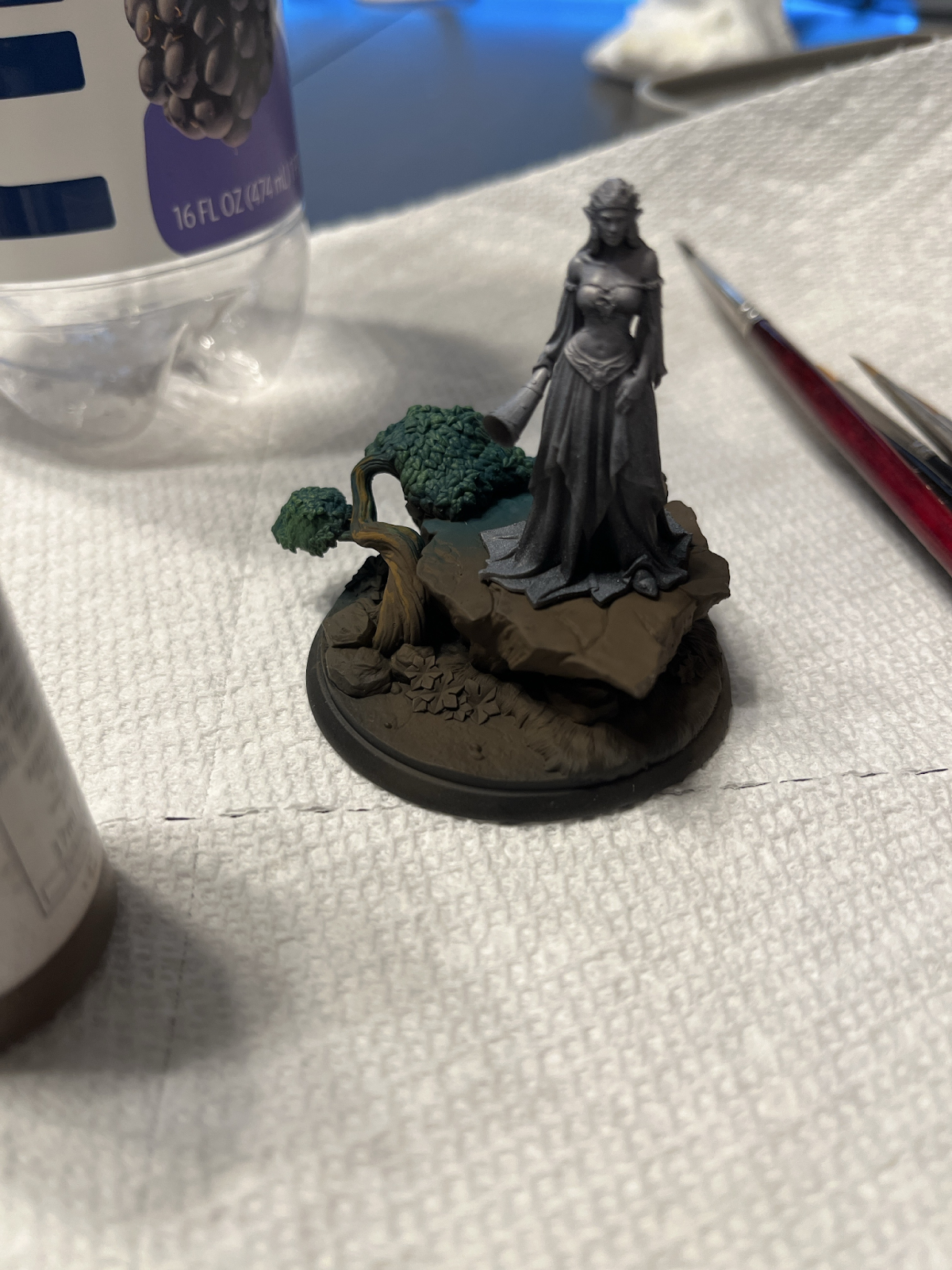
You can show—with the multimodal models—take a photo on your phone of a black primed model which is as yet unpainted and say, okay, this is a druid. I want a classic, muted summer color scheme for a druid. What will this look like once painted? Give me a painting reference so I can distinguish between the greens of her dress and the greens of a tree under direct sunlight versus the branches that are occluded by either the model or the other branches. And it will immediately give a photorealistic visualization of exactly that, with variable amounts of fidelity to the sculpt. But if you yell at the AI and say, hey, you have misrepresented the clothes she's actually wearing, please pay more attention to the sculpt—in particular the fact that for whatever reason the artist has decided that this druid has very enviable abs—it will then render as advertised.
[Patrick notes: The first photo is from the physical universe, early in the painting process for one of my models. The second photo is a requested “painting reference” from OpenAI’s Image Generation orchestrated by GPT 5.2. ]

]
I find it extremely useful for producing art, the thing I just do for the fun of it on some of my nights and weekends. And I've also found it useful for, among other things, cooking Christmas dinner, where I am an amateur cook but have not cooked that much since getting married now 12-plus years ago. And I found myself cooking Christmas dinner, including some things that I had not cooked before, and can ask it to look up recipes and then do things like, okay, you've told me to aim for this consistency on this thing. Here's a photo—am I shooting for this? "No, add more flour." Okay, adding more flour. Thank you, Claude.
Sammy: Part of LLMs being useful in my life is it's just having a competent, experienced friend that you can call at any point for help. I feel like my life—if I could press a button and have actual competent friends be there literally all of the time, I would press that button. But because I don't, I have a limited amount of social capital in this world, I get to just talk to Claude through web dev and everything else. It's so great.
Patrick: I definitely feel like there is a substitution effect for social capital going on where there are people I could call up at 2 AM with a problem, but the typical thing that has me awake at 2 AM—it's something that has me awake at 2am, but it's not a thing that I want to burn cycles of someone else on at 2 AM. I feel intensely averse to that. Whereas Claude has nothing but free cycles at 2 AM—that's probably one of their least utilized times—and so I'm very happy to throw it on either the thing that is keeping me up or even a passing fancy.
There was randomly promoted on YouTube a video from—unfortunately, there exists a supply chain which does IP theft, taking videos from Chinese social media and reposting them to American and other social media and attempting to monetize that. Be that as it may, one of the videos was interesting. It depicted a traditional process for carving jade, and that involved two workers who were using something which looked something like a band saw, except the saw blade was twine. And prior to using the saw blade, they had drizzled a purplish liquid, and they showed that being produced from purplish rocks that were ground with a pestle. And I thought, okay, not that I have any burning need for this, but—LLM on my phone—what is happening here? What is this purplish liquid? Is it an abrasive?
Yeah, it's an abrasive. And here's my guess for what gemstone they're using for the purpose of that abrasive, which is well attested to in scholarly work on traditional jade manufacturing.
[Patrick notes: GPT 5.2 put 80% on almandine garnet, 15% on an unknown corundum-rich abrasive rock, and 5% on other.]
Oh, great, can you explain to me, like, why—what is the physical mechanism for this?
Happily. It chats through how abrasives are deposited in the kerf, and the mechanical action of the crystal particles against the jade is what causes the cutting rather than the rope causing the cutting. I said, what's a kerf? "Oh, sorry, thought you knew that already. Kerf is the cut made by a saw or other cutting device in wood carving, stone carving, et cetera, et cetera." Oh, today I learned.
And you can just go arbitrarily deep on any industrial process at any time. And at least for the ones that I actually understand, it seems to be reasonably decent at those. [Patrick notes: e.g. Much of what it says about resin printing coheres with my limited chemistry education and this fantastic presentation by a chemistry PhD on that topic for the benefit of hobbyists.]
So our tradition is you pull up the most popular episodes and we step through some thoughts about them. What were the popular episodes for the year?
Sammy: Yeah, our most popular episode was your reading of the salary negotiation essay. I think it was "How to Negotiate Your Salary Package," which—yeah, that makes sense.
Patrick: Yeah, facepalm on this one. I think you suggested multiple times, "You should probably go through your back catalog of essays and read the ones that continue to have enduring utility." Also, Dave Kasten suggested this specifically. Also, many people suggested I should make a TikTok about salary negotiation just to help Generation Z about this. TikTok is still a bridge too far, but go figure.
The essay, which happens to be my best distributed work of writing ever, continues to have the existing audience and a new audience every year as people send it to their friends, loved ones, and similar. And immediately after recording the podcast version, the emails started coming in. "Thanks so much for that. I have never received negotiation advice before, but I successfully used that to get money out of capitalism." So Internet fist bump to you all, and it will continue existing on the Internet forever for the benefit of people who want to slightly renegotiate the balance of power between capitalism and themselves. [Patrick notes: Depending on exactly when you catch me I’m either a dyed-in-the-wool capitalist or a de facto labor organizer. I view those two as being less in tension than many in the world do.]
Sammy: The main other public thing I did this year was write an essay on freelancing that started life as a list of Patrick McKenzie essays to read, which was mostly "you should read salary negotiation."
Patrick: No, really, the blessing and the curse of this essay is I know it's the most distributed thing I've ever written, and periodically I think, well, okay, achieving massive distribution is not necessarily the entirety of my objective function, but that is occasionally useful. What other things in this genre should I write? And we did have one conversation this year with Billy Gallagher on negotiating equity, so doing some backfilling of the catalog that should exist if I'm falling backwards into being a labor organizer late in life. So that was the most popular episode. What was number two?
Sammy: Number two was, I believe, the Gary Leff episode on airplane rewards programs.
Patrick: I love talking about airplane rewards programs, even though I am not an inveterate optimizer of them myself. But it's a fun intersection of there is this economic organization, there is the instrumentally useful part, and some people actually do enjoy this hobby of points hacking and similar, and getting better at the points hacking is useful. It happens to be extremely professionally relevant to me to the extent that I write about financial infrastructure, because the dominant way to get points for people who are serious about it is using the airline's linked reward cards, which are some of the largest contracts written in capitalism. Fun fact.
And also, frustratingly, when the mainstream press writes about—they love this lens that "airline loses money flying airplanes but they make the money back on writing the credit cards"—which, you can listen to the episode or other places I've articulated this thought, but that is not the correct way to think about the world. These are two halves of a linked business, and the seigniorage income from the credit card program would not exist but for the fact of the route network and the product that people actually want to get from the airline. Go figure. A lot of journalists are economically illiterate, and they can allocate all of the revenue of the company to one division and all of the costs to another division and think that that pencils. But what can we do?
Sammy: Complain about it on the Internet.
Patrick: Complain about it on the Internet!
Oh, speaking of complaining about things on the Internet, the Atlantic, which—oh no, not again—did publish an article saying that poor people are paying for your credit card rewards, which is false. They published it in their opinion section, which is a section of the Atlantic which is allowed to lie. [Patrick verbalizes, for the benefit of the audience.] Sammy just had a look of disapproval on his face. It's just not true. They even say in the piece, "there are people in banks that say that this isn't true, but what do they know about banking?" [Patrick notes: A paraphrase. The direct quote is: The industry argues that swipe fees, not interest and penalties on poorer customers, finance its cash-back and travel programs, Ted Rossman of Bankrate, the financial data and news site, told me. But he does not 'totally buy that.' It’s all 'part of the calculation.']
So here's another geek on the Internet saying it's not true. And if you want to get that in arbitrary length, you can read it in Bits about Money or listen to the corresponding episode.
Sammy: Yeah, one episode that isn't in our most popular for the year based on at least the metric that we're using, but that should be, is the talk to the Bank of England. That was really good.
Patrick: And this is one of the reasons that my objective function is not optimizing purely for reach. There is a part of my brain which still remembers being the small software entrepreneur on the Internet, writing in a corner of an apartment building next to a Japanese rice paddy. And I'm cognizant of the fact that I've evolved a little bit since then, but my brain still definitely remembers it. Occasionally people in corridors of power do listen to what I have to say about things. And sometimes more than just listening to what I have to say, they seek me out and say, "Hey, will you come in and have a chat with us?"
And so I did have a chat with the Bank of England at their request. And then I did what I always do and say, "If I'm having a private chat, I would love to have a public chat to the extent that is possible and practical." And indeed it was possible and practical. And so the episode discusses what I told them—comments not endorsed by the Bank of England—what I told them with regards to stablecoins, systemic risk to the banking system coming from software development practices specifically, and the industrial organization of software even more than software development practices. But listen to the episode for more on that.
And also a bit of AI. Their particular lens—they were interested in hearing about whether the use of AI in trading firms such as hedge funds would cause correlated risk to the banking system. And I said, well, interesting topic. Talked to some people at some labs. And the thing that we really want to say to you senior decision makers for the government of the United Kingdom is that's really not where you should have your locus of concern for AI in the coming years. This is much, much bigger than that somewhat quotidian worry. So part of my job is laundering LessWrong into corridors of power.
Sammy: Yeah, I mean, there's so much value in doing that, right? There are so few people in the world who speak multiple languages in that way. You can see that some of the MIRI folk are learning to do this specifically as they publicize their new book. But the majority of people at the major labs do not know how to speak DC in any way that matters.
Patrick: I think 忖度 sounds cooler in Japanese. [Patrick notes: Sontaku, a form of anticipatory compliance, is frequently noted in discussions of how Japanese underlings related to their superiors, including in government contexts, including by Japanese authors. I think sontaku is much bigger than Japan. There was sontaku up and down the U.S. debanking issue, for example.]
This is true of tech companies broadly, by the way, which is why tech companies have government relations departments.
Sammy: Yeah, but most tech companies are not going to—I don't want to say need government intervention, but most tech companies have smaller effects on the world than these ones.
Patrick: The history of the last ten years in Silicon Valley and related spaces has been partially that Silicon Valley has accumulated an enormous amount of power, partly as a considered intended effect of doing the thing, partly as an unintended impact of just making things that people really want to use and making a lot of money doing that. But whether intended or unintended, descriptively, Silicon Valley accumulated a lot of power, and other actors in society said, "Oh, there is this massive amount of power controlled by people who are bad at wielding it. I would like that, please"—not always saying the word please when asking for it.
And so I think one of the under-discussed undercurrents of many of the local issues—both AI regulation, misinformation regulation, et cetera—has been this move by some people to turn tech companies into a fifth arm of the government. Essentially in the same way that the financial sector is a de facto arm of the government, which has been a recurring theme in Bits about Money and in Complex Systems episodes.
Sammy: I would also say that I think 2024 and 2025 are probably the years where tech companies, and specifically locuses of power in tech, are trying to also influence the government directly in various ways.
Patrick: I think that has always been a thing. Well, "always" is a strong word—government relations teams have factually existed for more than just the last two years, but there is a level of intentionality about it and level of willingness to throw elbows which did not exist for a few years.
As one of many data points one can point to: prior to the 2024 presidential election, Mark Zuckerberg wrote in his own name a letter to Congress saying that he felt that in hindsight, Facebook had agreed to requests from the administration which it should not have agreed to with regards to censorship, and that it pre-committed to fight requests like that from whichever administration was coming next or would come in the future.
[Patrick notes: Quoting Zuckerberg, “I believe the government pressure [from the Biden administration to censor speech perceived as increasing vaccine hesitancy, a subject on which I have views] was wrong, and I regret that we were not more outspoken about it. I also think we made some choices that, with the benefit of hindsight and new information, we wouldn't make today. Like I said to our teams at the time, I feel strongly that we should not compromise our content standards due to pressure from any Administration in either direction -- and we're ready to push back if something like this happens again.”]
I thought, that's a line in the sand that we really haven't seen before from tech. And also—I mentioned on Twitter—I would like to contrast this with three other examples of CEOs writing a letter to Congress pre-committing to fight an incoming administration without knowing who it would be. Except there do not exist three letters like that.
Sammy: Not yet. Growth mindset.
Patrick: Yeah. Anyhow, be that as it may, shall we return to the list of top episodes?
Sammy: Sounds good to me. We have the episode on Stripe AI.
Patrick: So, making my usual disclaimer before I discuss Stripe: I worked there for a number of years, have left their full-time employ, but I'm still an advisor there. But Emily Sands, who is deeply involved with their AI practice, came on the program to discuss some of that AI practice, how Stripe is training its own foundation models with regards to financial transactions, and why the business of doing transactions at scale just gives you a ridiculous data advantage for both collecting data to be allowed to train models, but also the particular physics of money involved in credit card transactions means you have interesting decisions to make which are both directly to the benefit of the business, to the businesses that are the customers of the product, and also to the broader financial ecosystem at large.
One of the things we discuss—not the sole use of AI in that business or any other, but a major one—is in fighting fraud. And the particular topology of credit card fraud, which I've discussed in a number of places, is that any infrastructure provider can be used as an oracle to determine whether a credit card is valid or not—what's called a card testing attack. But the actual damage caused by card testing will not be at the site of the card testing; it will be after the fraudster takes their pile of credit cards that they know are active back and resells it or hands it off to the other department in charge of extracting value from them. And so defending your own platform against the card testing attack minimizes the damage that is dealt to the rest of the legitimate economy and at businesses that might not directly be your users and at customers who might have no direct relationship to you.
So I think it is nice to see AI and machine learning being deployed for pro-social ends like that, with obvious positive business ramifications. Yeah, the wonders of scale.
So what was the next episode on the list?
Sammy: The next episode is the AI Data Centers and Power Economics with Azeem.
Patrick: We did a few episodes over the course of the last two years, and I hope to do more, on power economics specifically. I conceptualize Complex Systems as basically an infrastructure podcast with a broad enough brief that we can look at basically anything under the sun that is even arguably infrastructure. But power infrastructure—obviously extremely infrastructure—and might be the rate-limiting step for some of the build-out of AI in the economy over the course of the next, call it, ten-ish years.
I think different people who have looked into the economics of it have different opinions on exactly what the shape of that curve looks like, exactly where the limiting factors will bite, et cetera. But I think there is a lot of smart money premised on: no wait, bringing gigawatt-scale power online is actually potentially the hardest part. And so talking about what does that actually look like in the data center, what does it look like with behind-the-meter power generation—we talked, as I recall, a little bit about stranded energy assets, which are an interesting thing to understand exists in the world.
A stranded energy asset is essentially a small power plant—typically a small power plant, often a gas-fired plant—which was previously co-located with an industrial user. If the industrial user closes and there is no grid hookup or sufficient transmission capacity out to that power asset, it becomes "stranded." And a thing that crypto didn't quite pioneer but made industrial-scale use of was putting Bitcoin miners mostly directly next to stranded power assets, with the idea that the current owner of the asset is getting nothing for it and they might sell you power at better than otherwise achievable market rates if you could allow them to turn their expensive capex investment back online.
And after that trail was blazed by crypto, it's being followed by some of the data center hyperscalers—which means Amazon, Google, Microsoft essentially—to bring AI data centers online. Not the entirety of their power strategy by any means. But for more on that, take a look at the episode.
Sammy: Yeah, and it's also interesting to see a lot of the companies that these hyperscalers are partnering with are themselves the same firms that were doing the crypto build-out.
Patrick: I don't necessarily know that I will regret things that I said about crypto if they end up being key to the energy transformation, because it will not be the most efficient way to have gotten to an energy transformation. I will say, one line I think I said on Complex Systems, which is a bit of a bon mot, is that if the only thing we get out of the AI boom is infinite clean power, shucks, will have been worth it at the price. But I strongly think that is not the only thing we will get out of the AI boom.
Sammy: I am inclined to agree. Do you want to go on a brief tangent to talk about the logistics of recording at Lighthaven?
Patrick: I think this is the maximally tangent-friendly episode of the maximally tangent-friendly podcast.
Sammy: Yeah. Okay, we're going to put that on the website.
So previously, when Patrick was in town to record local episodes for the Bay Area, there was a lot of not just scrambling to find guests and make the scheduling Tetris work, but also logistics on top of that. We needed to find a venue to actually record—PeerSpace is a godsend for this—but we had to find a venue, we needed to get the equipment online, and then we needed to get the guest and Patrick to the venue itself. And all of that just took time and energy and money in a way that just was not conducive to filming as many episodes as we might want to film—or recording, as it were.
And so for what was called Festival Season this year, which was three, eventually four, conferences all around the same time in the summer, I went to the people running those conferences and said, "Hey, I think these conferences would be better with a podcast studio at the venue. I am willing to mostly pay for this with the client that I'm working with, who this will just be clearly net positive for, and then we can just have it set up as a public good for other people who might want to record there."
And we managed to make that work for everybody. I had a videographer friend of mine set up some video cameras because we were like, okay, we might as well do the more ambitious version of this and potentially turn Complex Systems into a video show.
And I gotta say, some parts of that were really fun and easy and rewarding, and some parts of that were not. Do not do what I did, which was: "I don't really want people to be messing around with the cameras or having to press buttons ever. I am just going to leave all five 4K cameras recording constantly and put them all on a hard drive and upload them all to the cloud." The part of that that was really painful was when people wanted their footage—specifically, I would have to manually cut down footage on my not-great laptop from all five camera feeds and then find a way to send it to them. And it turns out Dropbox does not handle large video files well, which is not a fact I knew going into this project. Whatever you do, don't do specifically that.
But everything else—I think a good couple podcasts started from that. I think Adam Jarvis's Public Service podcast is downstream of those Lighthaven episodes. Parker Conley also recorded some stuff, and a lot of people recorded episodes of their ongoing podcast. And I'm also quite happy with the episodes that we had on Complex Systems that were recorded at Lighthaven.
Patrick: Yep. Adam Jarvis, who also appeared on this podcast, interviewed me for his own, and it was a really good focused episode on the VaccinateCA experience.
Yeah, I'm a huge fan of creating public goods as one operates a business. The classic way to do it in software is throwing out open source. But particularly given that we had a high-trust environment available—you can't simply leave five 4K cameras on the streets of Berkeley and have that work out well for you. But given that the majority of people coming into Lighthaven were extremely unlikely to, you know, strip a room clean of camera gear, it was relatively easy to make available within a particular social milieu.
And I think it's a thing that companies should do. Speaking as someone who previously worked in a marketing communications department: if you're at the point of having a software company that actually has a marketing communications department, you almost certainly want to have an on-site recording room available. You'll get so much bandwidth out of it. It's 2025. You're doing social media marketing. Videos perform very well. You will get something out of it for every launch in the future. It also makes it trivial to arrange an internal podcast, which is something that almost every company should be doing, particularly if you're large enough where the CEO doesn't literally have face time with every employee of the company every month. That is an easy way to arrange that, given that you have your on-site camera room, which you should have. Making it available to your own customers or to people's side projects, or a 17-year-old in the community who has an interesting thing to record, is relatively low lift and rounds to zero marginal cost. So strongly consider doing it.
Sammy: Yeah. One of the great things about podcasting as a medium, especially if you're doing a company podcast or something, is that from both a time and mental energy perspective, it is so much easier to get knowledge out of people than trying to get essays out of them. Frankly, I prefer reading things in written form in carefully edited essays to listening to podcasts, but it is so much easier to make a lot of podcasts than it is to make a lot of essays for the majority of people. And so if the thing that you want is for the CEO to get face time with people at the company and to explain how they see the world, having them show up for an hour to record a podcast is so much simpler on their end as a way to put that knowledge out.
Patrick: There are intelligent people who don't show to their advantage in interview settings or podcast settings. Acknowledging that off the top, I do think that it is vastly more common that people show to advantage in an interview setting, and are able to speak off the cuff about the topic that is their life's work versus being able to write to the standard of the best writers of the Internet about their life's work.
Yeah, there's definitely a time efficiency reason there. I think there's also—it is under-discussed, but there is something about the mark-zero human monkey brain which is still running SimianOS where seeing a face and hearing a voice, particularly the hearing of the voice, causes you to really believe in your heart of hearts that someone is your tribe in a way that reading their words on the page does not cause.
I consider myself more of a writer than a multimedia personality, but when I meet people, the ones who most obviously feel some sense of deep personal affection for me beyond just "you are one of many smart people on the Internet and I've read your words for 20 years"—they are almost invariably podcast listeners, despite the fact that my writing is, I think, subjectively better. And it is certainly better distributed than the podcast, although far less regular. Thank you, Sammy. We successfully did—what, almost 50 episodes last year?
Sammy: Yeah. And I think a similar amount this year.
Patrick: Oh, I was saying 2025. It's not quite last year yet.
Sammy: We are recording this on December 30th.
Patrick: Yep. But closing the loop on the thought: yeah, definitely run an internal podcast for the purpose of getting people to meet their coworkers and have a sense of regard and affection for them. Or, if you prefer, your employees—who you are worried about leaving for other firms in a vibrant economy—will have a sense of love and affection for the people who do put out podcasts.
Sammy: Yep. One last note on that: one of my favorite books that I've read in the last year or so is A Diary of a Very Bad Year, which is just a collection of interviews with a hedge fund manager about the financial crisis as it was unfolding. And there's no way for that to have existed if it wasn't for this guy who edits for a literary magazine being introduced to this hedge fund manager and doing a couple interviews. It's not like the guy was going to be writing essays about it, but he's so good at explaining how society misallocated capital and is now paying for that consequence that—I'm very glad that those interviews exist. And it wouldn't exist if it wasn't for interviews.
Patrick: Yeah, the world is fractal in detail. One of the things I love about Complex Systems is we have the organized excuse to go out and talk with people who understand some of the details in arbitrarily niche-down topics. I can't remember if it was last year or this year that I interviewed my father about bank siting and other fun real estate stories—but I think last year.
There is almost nobody who has had a long and interesting career who doesn't have fun stories about that and the things that civilians don't understand about our industry. And I will never get tired of hearing them. Should have my dad on at some point again, but neither here nor there. So did we have another in the top five?
Sammy: I think we're good on that for now. Can you believe that—I think the Bits about Money on the banking adventures came out this year, in 2025.
Patrick: Yeah. Oh, that feels like forever ago. So that was a capital-P Project for both of us. And for people who don't remember the timeline: there was a writer victimized by a scam in October of 2023, who wrote an article in New York Magazine / the Cut which was published in February of 2024, kicking off an investigative journalism project from Bits about Money and from Sammy, about some of the facts underlying a key element of that scam article. And due to ultimately foot-dragging by various public institutions in New York, it took us forever to get it out. But we published—January, I believe, of this year, 2025—and then did a Complex Systems episode about it. That was fun.
Sammy: Very much so.
Patrick: I'm glad I'm not a journalist and don't intend to be breaking news that frequently, but when something so squarely lands in my beats and exercises—the number of people who called me autistic with regards to banking procedure in comments about that episode—I, you know, bracketing the Internet's use of that term versus the medicalized use of that term and bracketing my own medical history, I do like banking procedure, and so was happy to be able to chase it for as many months as required to satisfy intellectual curiosity about it.
Sammy: While we're at year-in-review, we may as well do the year-in-review greatest Patio11 tweet, which was not written by Patio11. “Patrick McKenzie's life seems to be full of insane problems where Patrick McKenzie happens to be the exact optimal person to solve them” [Patrick notes: Tetraspace, on Twitter. I’ve replaced Sammy’s verbal paraphrase with the exact tweet.]
Patrick: I do like the funny Twitter bon mot of this. I also think that everyone's life is designed to expose them to problems that they are the perfect person to solve, because it's a self-reinforcing cycle. You tend to do the things that you are best at, and you will tend to situate yourself in social milieus which bring you the kinds of problems that you have been dealing with before. At the same time, I do occasionally find myself in a bank where—thanks guys, you're giving me more tweetable content.
Sammy: Regional Wire Transfer Compliance Influencer.
Patrick: Yep, I get that a lot. That was the thing that brought me to the Bank of England originally when my pound notes got demonetized a few years ago. Although I didn't actually have to go into the bank because I'm good at being a banking compliance influencer and was able to sweet-talk a high street bank in London to give this unbanked American access to the new non-demonetized notes. Oh boy.
Sammy: Do you remember what I said to you when you were proposing to send me to New York in what was effectively the second ever task I would be doing for you, back in March of 2024?
Patrick: I don't remember specifically what you said there.
Sammy: It was something along the lines of, "Look, I would be more than happy to go to New York to do this for you. Are you sure that you are not making a financial decision you're about to regret?"
Patrick: You recall this conversation. And, you know, it's a business.
Sammy: Yeah, I have a much better understanding now.
Patrick: I'm glad I'm not an investigative journalist. The business model for investigative journalism is just so rough, because—not that we are the benchmark for investigative journalism. But if you are writing an ambitious piece which will require having a reporter and research staff run after something for four months, and you monetize it in the typical way journalism is monetized, some combination of subscriptions and advertising revenue—investigative journalism really does not pull the clicks as much as things that are one, much more efficient to create and two, vastly lower social value, such as clickbait, rage bait, top 10 articles, lists, year-end review articles, et cetera.
And considered narrowly from "how many subscriptions of Bits about Money did it sell" to do follow-up reporting on an article which appeared once in New York magazine—not that many. But it's an expenditure of rent, and also a sort of position piece, that this is a professional journal. We are allowed to do ambitious things occasionally and can chase after the ambitious things and do marginally less ambitious things in other issues as the spirit moves us.
Sammy: Yeah, that was that year's VaccinateCA.
Patrick: I don't know. Okay, so there's a sliding scale of ambition, and running core public health infrastructure for your nation is somewhat larger on the scale of ambition than maybe writing an investigative journalism piece.
Sammy: That might be true.
Patrick: But be that as it may, anything else that you want to make sure we get into the episode?
Sammy: Did you want to talk a little bit more about the process of making that game?
Patrick: Yeah, let's chat about the game for a few minutes. So for those of you who didn't see it, it's still up on the Internet and I'll be writing about it in more formal detail later. But Isekai Game is a fantasy roguelike, sort of, that you can play, which heavily featured AI both as an element within the game and as a technology for creating the game itself. It's similar in character to the intellectual heritage of computer role-playing games—CRPGs—so like Baldur's Gate or similar, where you have a few dialogue options and some of your dialogue options can have a skill roll and result in success or failure.
Unlike more recent entries like Baldur's Gate, there was no $100 million investment in art assets. Thankfully, as I couldn't quite afford that. But I did buy a lot of tokens, and the tokens were both paying for Claude Code and Cursor to write things and also for a few runtime decisions made by the game. One of them, which we debuted to people at Ricky's conference Metagame—what a wonderful name for a conference—it would slurp in their Metagame attendee profile and allow them to represent themselves within the game, which is a thing that every role-playing game that has ever had a character creator has had.
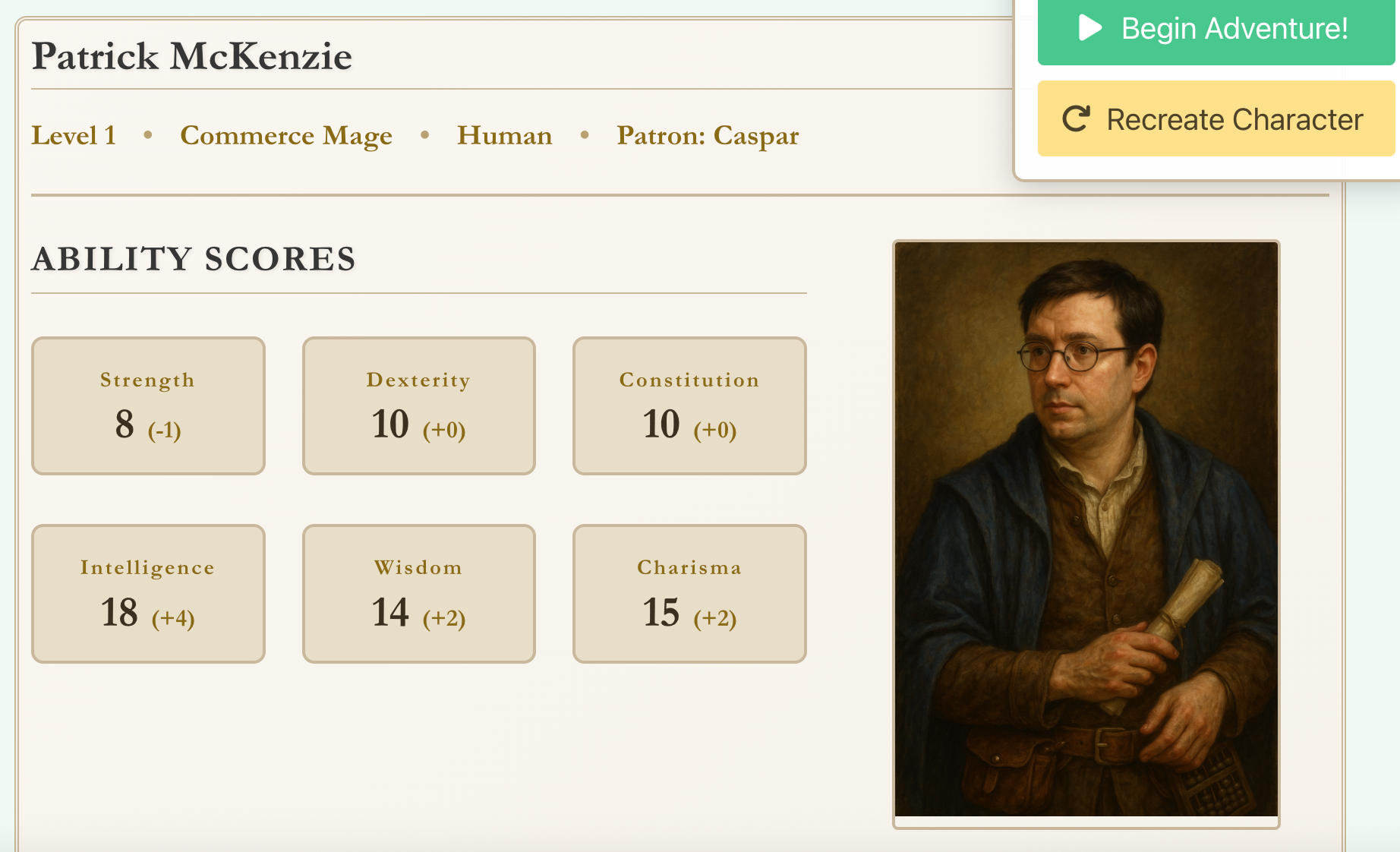
A lot of people like to make themselves in video games. That's part of the core fantasy. But given that the isekai genre specifically is about transporting someone from the real world into a heavily gamified fantasy world, I thought, oh, that's both a feature that is uniquely possible now that we have LLMs that can look at—without loss of generality—your conference profile and write a character sheet for you based on that, and even do a portrait of you based on your conference portrait, whatever you choose that to be. That was a fun exploration of what is possible and novel with modern LLMs available as an element within games.
I'm looking forward to both finishing the game at some point in the next couple of months. I had thought I would finish it in November but didn't get around to it. The game has a three-act structure as many games do, and it has a satisfying final encounter for Act One and no satisfying encounter for Act Two and Act Three. So I want to finish that, and then do a bit of polishing and also do some other enhancements, but more on that as it develops. The game should still be playable at isekaigame.com, and if you enjoy that sort of thing, you might enjoy it. People tell me that the satisfying final encounter, which is a bit of—I don't want to spoil it. I will say it's a pandemic-themed murder mystery.
Sammy: Oh no. Oh, so it's Pathologic. [Patrick notes: Incredibly given my interests, had never heard of this before.]
Patrick: It's fun, it's intellectually interesting, it's morally challenging. And during developing it, I got multiple—there's a term of art in our community, "feeling the AGI"—and I was chatting with I want to say it was an earlier version of Claude Opus, so 3.x probably, back at the time, and said, okay, no spoilers here, but I want this encounter—mini-adventure within the game—to use a fictional, fantasy-world-plausible illness. I want that illness to have a plausible biological mechanism to it. I want that biological mechanism to be something that would be understandable and plausible in the real world. But it can't exactly be typhoid, and it can't exactly be a respiratory illness, because I think players will be too genre-savvy about those. Help someone who is not an epidemiologist out.
And Claude came back immediately with, "Oh, okay, so here are five ways that epidemics can spread." And I immediately said, oh, number four is great. And I suggested a thing to it which would be a super spoiler for the event, and it was like, "Oh, you absolutely have to do number four." I'm like, absolutely have to do number four.
And at the end of that chat—this is the wild thing—I said, great, recap this chat in the form of a design document for this encounter, because I'm going to pass it off to Claude Code immediately. And that did not successfully one-shot the entire encounter, but had something minimally playable within—call it—hours of that "distill this essentially brainstorming chat between two collaborators into a production-ready design document and then immediately off to the implementer" process. And we had the first playable version of that in hours. And again, the entire game's development cycle was one month long. So that, I think, was the final week or so sprint of the game.
Enormously, enormously interesting. There's a level of power in these things which I am still plumbing the depths of, and I think I will be plumbing the depths of for a while. It was—I considered it more of an art project. There's no price tag on the game and likely will never be, but it was a fun, intellectually engaging art project. There is a story particularly embedded in that plague encounter, but throughout the rest of the game, that I feel—even though I was not the sole author of it, a lot of the sentence-level prose was written by an AI—but I was the overall, let's say creative director of a lot of it, and felt that I was getting my money's worth as the creative director for the tokens I was spending. And people who played it say that there is very definitely a feel like I have my thumb on the scales of that universe, which was desirable while still making it fun for other people.
So your mileage may vary, but if that sounds like your thing, isekaigame.com.
And I guess that leaves us in a pretty good place for this year in review. Sammy, for people who don't follow you generally, where can they find you on the Internet?
Sammy: Yeah, head to my site. The public work I am most proud of this year is an essay on how to end up being good at freelancing.
Patrick: Nice. And thank you very much to everyone for listening to Complex Systems. Obviously we are here at Complex Systems. However you found it, we'll be back here next week. Also Patio11 all over the Internet.
Before I sign off: I'm always trying to up-level the ambition of this podcast and the other things I do. And I know something of what the guest pipeline looks like for the next few weeks and months, and obviously we have some episodes of it recorded already. Hope that you will enjoy some of those episodes, but more about that when they hit the Internet.
All right, thanks very much everybody and see you next week.
Sammy: Hey, thanks for having me, Patrick.
Patrick: Thanks for tuning in to this week's episode of Complex Systems. If you have comments, drop me an email or hit me up at patio11 on Twitter. Ratings and reviews are the lifeblood of new podcasts for SEO reasons, and also because they let me know what you like.