YouTube economics now, with Justin Kuiper

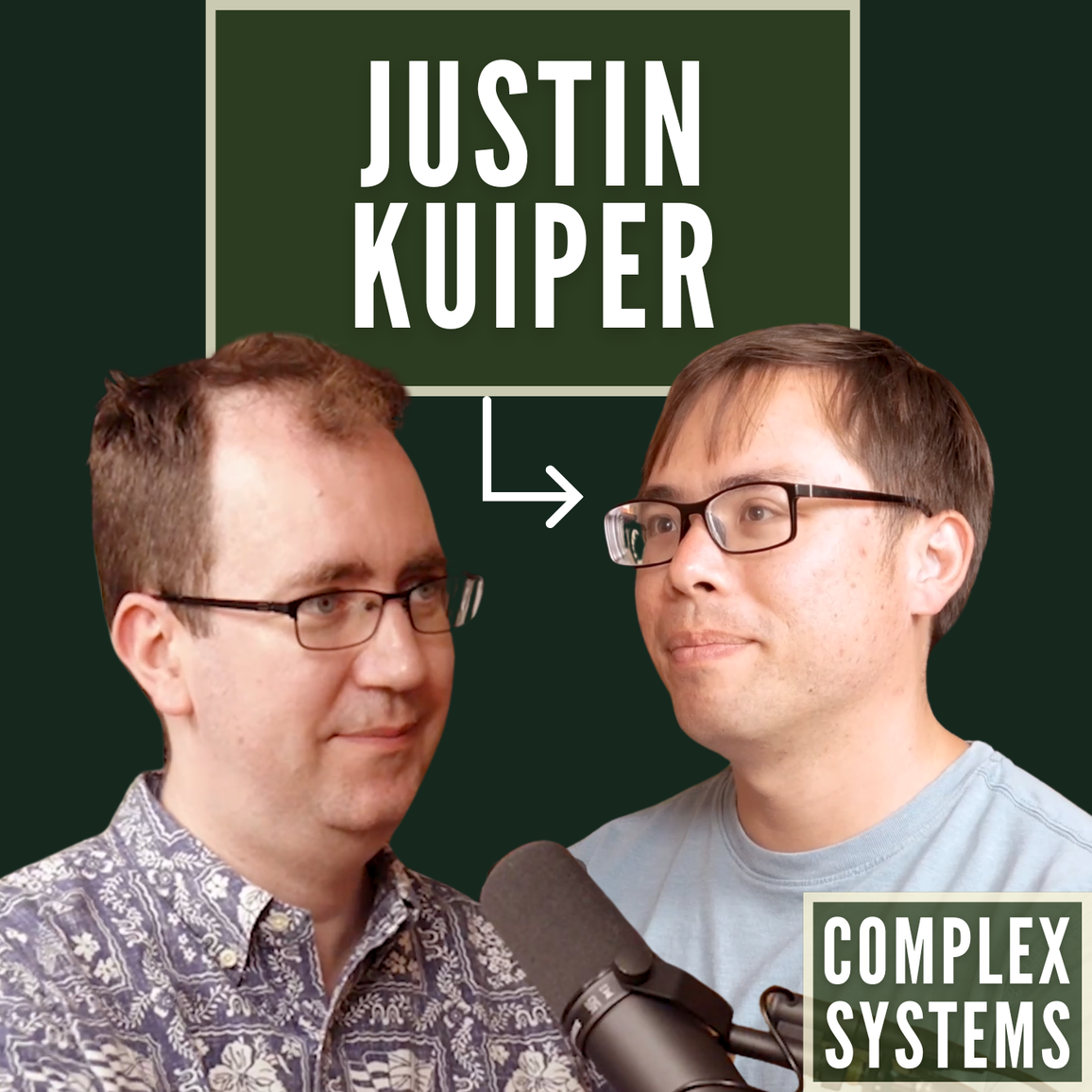
In this video episode of Complex Systems, Patrick McKenzie (patio11) is joined by Justin Kuiper, a longtime writer for MatPat's Game Theory family of channels and now creator of Proof Positive, to discuss the microeconomics of YouTube. They break down how creators actually get paid — from $3–$20 CPMs and the leaky funnel where a million views yields perhaps 50,000 actual ad views, to sponsor reads, Super Chats, and MrBeast selling chocolate bars as his own advertiser of last resort. Along the way, they explore how a successful channel becomes a firm that absorbs specialist labor from less successful peers, why the algorithm gives every upload a trial by attention, and what parasocial spending has in common with Mark Twain's speaking circuit.
Make sure to subscribe on YouTube.
Presenting Sponsors: Mercury, Chainguard & MongoDB
Complex Systems is presented by Mercury—radically better banking for founders. Mercury's new feature Command brings an LLM directly into your banking interface, so checking balances, finding invoices, or sending a wire is as easy as asking. Apply online in minutes at https://mercury.com/.
If attackers are using AI to weaponize code faster than any team can review it, your scanners won't save you. Chainguard builds libraries and container images from source, verified all the way down, with near-zero CVEs and zero malware. Build safely at https://www.chainguard.dev/.
What's the point of building faster with AI if your database can't keep up? MongoDB's native data model mirrors the language LLMs already speak. Ship at the speed of AI while staying ACID compliant at Fortune 500 scale. Start building at https://mongodb.com/ai.
Timestamps:
(00:00) Preview
(00:45) How creators make money on YouTube
(04:06) CPMs and the international ad market
(06:36) From solo creator to firm: working for MatPat
(09:28) Sponsors: Mercury | Chainguard
(12:30) From solo creator to firm: working for MatPat (cont’d)
(13:49) YouTube as a farm league for other industries
(17:15) Why now is the best time to start: discovery and universal basic attention
(20:47) Power users and how recommendations work
(24:23) Brand safety, rabbit holes, and the money laundering short
(27:38) Fads, timing, and the day-two piece
(35:52) The production function: scripts, shot lists, and editing labor
(42:14) The aesthetics of authenticity
(46:58) Sponsor: MongoDB
(47:47) Why more people should make videos
(53:52) Content marketing, sponsor reads, and remnant inventory
(01:00:24) Chocolate bars, paint sets, and creator products
(01:05:00) Parasocial relationships and the market in status
(01:16:43) Where to find Justin: Proof Positive
(01:18:58) Wrap
Transcript
Patrick: Hideho, everybody. My name is Patrick McKenzie, better known as patio11 on the internet, and I'm here at Lighthaven, sometime between LessOnline [Patrick notes: misspoke and said LessWrong live; LessOnline is a more-and-less related conference] and Manifest, with my buddy Justin Kuiper.
Justin: Hey, Patrick. Great to be here with you.
How creators make money on YouTube
Patrick: Thanks very much for coming. So we're gonna talk about the economics of YouTube today, and I suppose the microeconomic view most of all — how creators actually make a living, and how so much of this is not really legible to people that are behind the screen as opposed to behind the camera.
But let's start out. In the mists of prehistory, there was YouTube, and someone got on, they made some videos, some people clicked on them. How does that person actually make money before they get good at this?
Justin: There are several ways that you can make money on YouTube. I would say that YouTube revenue became real in the early 2010s when they added TrueView ads, the ads that you can skip. And this is when the financial incentives on the platform became very different. There was very much an initial land grab during that period, when there was a lot of capital investment, because people realized, "Ah, this is a place on the Internet where you can make money." Then downstream of that, there is, of course, all of the people who contribute their labor to the engines that are YouTube channels without being YouTubers themselves in the sense of being on-camera talent.
I can speak more to either side of that if you would like.
Patrick: Sure. I think the land grab dynamic is something that we see very often as new platforms get developed, where people, for whatever reason, assume that a new platform will be won by incumbents on the old platform. But often, when the form factor for the new platform is discontinuous with the old platform, this isn't the case.
And so while there are certainly name-brand comics that are on YouTube, the people that won YouTube comedy in the late 2000s, early 2010s were largely not name-brand comics. And you mentioned earlier that the singer that won YouTube was this no-name Canadian, Justin Bieber, rather than somebody that actually had a recording deal. [Patrick notes: See his Wikipedia entry if you’re curious.]
Justin: Yeah, I think that both sides of that are true to a certain extent. This was especially true back in the early days of YouTube. If you logged onto YouTube when you were signed into your account, it would show your subscriptions. But if you went to youtube.com for the very first time as a brand-new user, they want to show you something that is corporate safe. They want to show you something that if you are a teacher and you type youtube.com into the address bar in front of your classroom, nothing embarrassing is going to appear on the screen. And so that is the world in which clips of Jimmy Kimmel become one of the main forms of safe content on YouTube.
Over time, they have gotten much better at realizing, "Ah, well, we have this fellow, Mark Rober. He was not a preexisting celebrity, but he has put in his time as a YouTuber. He has revealed himself to be somebody who creates safe content that you can put in front of ten-year-old eyes without upsetting anybody." And so over time, they have managed to just discover the creators on their own platform. But there was definitely a period after the initial land grab when it took time for the attention to make its way down to the platform natives, as it were.
CPMs and the international ad market
Patrick: So my understanding is for the core YouTube ad units, the skippable ads that you were mentioning, they're primarily sold on a CPM basis, which is cost per mille. For those of you who don't make your mortgage doing advertising, cost per mille just means for 1,000 people watching a video — and perhaps there are some people that are included or excluded in this, but at a gross level, for 1,000 people watching the video, you get paid X amount of dollars. [Patrick notes: Adtech has entire ecosystems within ecosystems for counting people/sessions/IPs/cookies/etc in or out and pricing them.]
Can you give people a range for what CPM ads are on YouTube?
Justin: Yeah, it very much depends on the vertical. If you are showing Minecraft videos to 13-year-olds, your CPM might be closer to $3, and if you are showing luxury watches to the type of people who click on videos about luxury watches, then your CPM might be north of $20. But a fairly standard ad rate for what people would think of as a YouTuber is between $3 and $10 CPM, with obviously outliers on either end.
Patrick: One of the things that interests me about this is YouTube is an intensely international business, and CPMs vary wildly based on the country someone is in, for fairly predictable reasons if you think about it. There has to be an advertiser that is willing to pay the YouTuber's received CPM, plus a cut to Google/Alphabet, whatever they're calling themselves these days, to be able to run an ad. And purchasing power is generally speaking lower in India than the United States, the number one ad market anywhere, or for example Japan, which is 90-ish percent of the US on most CPM surveys that I've seen. And then there's a bit of a trail off to Europe, and then a large, large gap before you get to very large user bases in places like India or China — I suppose a larger user base in India, due to lack of a great firewall. This goes into the mix when people are both looking at their revenue analytics but also making business decisions for the platform.
And this is one of the takeaways I would most like to leave people with: YouTubers are businesses, and some of them are sophisticated about being businesses. You spent some time in the trenches yourself. Can you talk about when someone is no longer a creator just doing their own thing, throwing stuff up at the wall and seeing what sticks — when you start to adopt the form of capitalism, what changes about the YouTube production function?
From solo creator to firm: working for MatPat
Justin: Sure. To give a little bit of my own background, I spent most of the past eight years working for a YouTuber named MatPat. Game Theory, Film Theory, Food Theory, and most lately Style Theory are names of channels that you might have heard. I was a writer on all four channels and also briefly worked as a creative director on Food Theory.
One of the things that not a lot of people realize — I think MatPat is one of those YouTubers that people generally think of as a guy who talks into a microphone and then hits upload. But if you look at the credits for any of his videos, and/or now the people that he has sort of handed those channels off to, you will see somewhere between five and 10 different people credited.
To your point about the engine of the YouTube channel being something that can absorb talent from multiple sources: I have this mental model where you might have 10 YouTubers who are all moderately successful, in the sense that they can upload a video and make maybe 100 to a few hundred dollars in ad revenue. This is comparable to what you would make working at a Costco. So you might have 10 of these people who are all making a modest living on YouTube. One of those YouTubers is marginally more talented than the others, or just catches on in a specific way, and oh, they grow to 10 times the size of the other YouTubers. Also, for reasons of the sort of Matthew principle, 10 times as much attention translates into more than 10 times as much revenue, because now they are more attractive to advertisers who are willing to offer them better terms. So not only are they getting more attention, but they're also getting a better rate on their attention.
It then makes sense for them to look at all of the people that were previously their peers and say, "Hey, you are not as successful as me because you are really good at writing, but you're not a very good editor. Why don't you come work for me? You will get to do the thing that you like the most, do only the thing that you are the best at, and this will be a beneficial trade for both of us."
And so this is what I think a substantial number of the people who set out to be a YouTuber end up discovering: if you are making YouTube videos at around 10,000 views per video, you are probably making around 30-ish dollars per video in AdSense. This is not really what you would think of as real money. But 10,000 views on a YouTube video is not insubstantial. You are pretty good at what you do if you can get 10,000 views on a long-form YouTube video, and one of those 10,000 views is fairly likely to come from somebody who can say, "Hey, I like your editing," or "I like your writing," or a particular thing that you do. "I would like you to come and work for me, and I will pay you more than the $30 in AdSense revenue that you were previously getting."
Patrick: Yep. They have a better economic engine to attach your labor to than the economic engine that you've been able to cobble together yourself. And this is something we see a lot in the economics of the internet, where people often lament the death of the blogosphere. But if you go back to, I don't know, 2004 or 2010, when the blogosphere was a hip-hop-happening place, those people mostly didn't die. They got snapped up by places like Bloomberg; some of us joined the tech industry, et cetera, et cetera. And it turns out that if you are talented at writing words on your own blog and are also talented at writing words for the tech industry — which has the monetization figured out, because software is a high-margin good — the tech industry will pay you very well to write coherent words about basically any topic relevant to their interests.
[Patrick notes: One of the most common frustrating responses to “Can we hire XYZ, who has a good tech-adjacent blog, to do writing for us?” is “Are you prepared to buy their company?”, incidentally. Many of the best known writers in the industry are primarily founders who just happen to write; most of the writers who just happened to found have already found gainful employment.]
And I think that is starting to happen to YouTube as well: there are people who are identified as being marketable talent on YouTube, perhaps at Justin Bieber levels of talent or perhaps just otherwise interesting, and then YouTube gets used as the farm league by other industries. You had some examples of that. Apparently one can see them in movie theaters now?
YouTube as a farm league for other industries
Justin: Yes. We are recording this in the month of June, where this afternoon you could go to the movie theater and see one of Obsession, The Backrooms, or The Amazing Digital Circus, which also has a movie event that is going on. These are all things that have made their way to the big screen, and these — especially the first two, Obsession and The Backrooms — are downstream of film investors who saw people who were successful on YouTube. They say, "Okay, you can create an interesting 10-minute video with a modest budget. Let's see what you can do with half a million dollars or a little bit more than that."
Patrick: And my understanding is those are horror movies, which is a classically low-budget kind of genre. But it's also because it is classically a low-budget genre that that's how a lot of people get their start in Hollywood, both on the director side, and even some of the stars often have an embarrassing horror credit or two in their filmography.
Justin: Correct. Another example of this that comes to mind is Markiplier earlier this year also put out a self-funded horror movie into theaters.
Patrick: So there's definitely a pipeline between the blogosphere, or the written word, and other corridors of power — the blogosphere is a corridor of power in 2026. This has been demonstrated more than enough times by now. People go from that to DC, to working in congressional staffs, to working at think tanks. They go into the prestige media at some greater-than-zero base rate. They go into the tech industry and become either PMs or work in the marketing/communications shops in the tech industry.
Is there a similar flow between “person got discovered on YouTube, but it turns out maybe they would be better off working in a Congress office” or something?
Justin: There aren't any examples that come to mind specifically for policy. That being said, I did mention MatPat, who has sort of left his career as a YouTuber to go to DC to talk to policymakers about things that he thinks matter to creators. Although I get the impression that he's not doing that for financial incentives. He's not doing that to make money.
Patrick: Mm-hmm. I think very few people go from successful careers to DC with the intention of "there's just so much money in DC" — with the partial exception of if you work in national security, then contracting national security in DC probably pays better than the usual ways to start working in national security. But one generally doesn't go into working for the government directly because it pays so much better than tech. Ba dum bum, understatement of the year.
We've talked about a few of the models where someone has a working business model on YouTube and can kind of attach talent to it and make that more successful in a way that is better for them than them being their own firm — a great theory-of-the-firm example there. But I think that also causes something of a professionalization and an arms race among creators, particularly as the platform has grown in economic impact over the last couple years. Conversely, you've told me that it's also the best time to become a creator from ground zero. Can you help me square that circle?
Why now is the best time to start: discovery and universal basic attention
Justin: Sure. So I alluded earlier to the period with the land grab in the early 2010s. There was a huge incumbent advantage for some of the reasons that I articulated. I think there was also a big problem with indexing content, right? You always hear the stats about how many hours of YouTube footage are uploaded every hour, and if you are in the year 2015, how do you take all of this upload and figure out what is the good content that we should recommend to people, and what is the bad stuff that should get buried?
So partly this is downstream of machine learning developments. Now, after the attention paper one of the things that will happen if you upload a YouTube video today is that there will be a process that scans the semantic content of that video. Now, this is presented to the user as, "Oh look, we created these subtitles for you so that people who are hearing impaired can enjoy your video. Isn't this a lovely thing that we've done?" And I think it is. But also, what they have done is they now can have an LLM look at the script and say, "Ah, we now know what category this video exists in. Also, we kind of have an idea of how erudite this person is. Are they speaking the lingo of the youth? What kind of sophistication are they expecting from their audience? This also lets us figure out who to recommend it to." This is kind of speculative on my part, because obviously this is proprietary and they will never fully reveal what is going on, but I think there are reasonable inferences that can be made.
Also, substantially, there was a significant amount of pressure that has come from TikTok as a competing video platform. One of the things that has made TikTok really take off is that TikTok prioritizes content discovery. One of the things that TikTok realized they could do with user attention is that users could use their attention to signal. Part of what you are doing as a TikTok user is you are filtering through the slush pile. If you are one hour into a TikTok session, they know that they have you hooked. They know that you will keep on using the app even if they show you, quote unquote, "a bad video." So what they will do is say, "Hey, here's a video with literally two views on it. We don't know if it's good or not. We'll put it in front of you and see if you watch it for more than a set few seconds or if you just swipe to the next thing. We know that we won't lose you as a user." Basically, if you upload a video to TikTok, it's pretty much guaranteed that it will get 100 impressions, so that they can figure out: is this a good video or not?
Patrick: I've heard this referred to as Universal Basic Attention. Everyone gets at least 100 people's time of day, and then if you do well on that, you get continued to be awarded more attention, until the point where the algorithm decides: nope, you've had enough. The people we are exposing you to at the margin do not consume you preferentially to other things we could be showing them.
Justin: Yes, and I think this is something that people have probably experienced on YouTube. If you are a power user who watches more than 10 hours of YouTube videos per week, you probably have had the experience of: you open up the YouTube app, you scroll, you see things that align with your interests, but then you also see a video that has literally 20 views on it. And you might ask, "Why is this crappy content being put on my feed?" And the answer to that is: why do guilty people get a trial? We don't know that it's actually crappy content until we have put it on trial and then let users render their verdict on "is this worthy of my click or not?" And then, among those who click, "is this worthy of more than a few minutes of my attention or not?"
Power users and how recommendations work
Patrick: You said something about YouTube power users, which I think is a really important concept for people to have if you haven't worked in, say, product management before. Obviously YouTubers are YouTube power users, but they're considered separately from people in the viewing persona. And there are some people that watch YouTube a lot more than you do if you are listening to this podcast — 40 hours, 100 hours plus, per week.
[Patrick notes: 40 makes you a basically typical American adult who has replaced your TV with Youtube; 100 makes you a hyperconsuming outlier. “Hyperconsuming outliers” are a very useful concept to understand about creative industries, and one I originally gleaned from a since-forgotten essay on the economics of Japanese manga/anime/etc. Why so many harem animes? In part because Harem Hikaru, who is single-digit percentage of the total anime market, spends tens of percent of his total income on harem anime goods. This (plus the pipeline between Hikaru and creative decisionmaking for the industry) tends to get his preferences met in substantial quantity.
A perhaps less aesthetically unpleasant tribe of hyperconsuming outliers are political partisans or romance novel readers, who both extremely outindex the rest of the population on consumption in their particular areas of interest. Oddly enough catering to partisans is generally seen as high-status in the media industry but this is broadly not true of romance novels.]
And given that while it isn't the case that you monetize as well in your first minute as in your 600th minute, the curve there does not go down nearly as steep as you think it would. And so the people that YouTube designs around are largely folks that spend — a judgy way to say it is an inordinate amount of time on YouTube. A somewhat less judgy way to say it is: they use it as their primary media consumption platform, in a way that people once used television.
And so if you are a power user, if you use it like some people use television, you have more of a thumb on the algorithmic scale than someone like me, who might watch 30 minutes once a week or less than that. And presumably there's some graph at the Googleplex that shows how many people are three-minutes-once-a-year YouTube users — that user almost mathematically has to exist. You can justify optimizing for pushing them into a bigger bucket, but you can't really justify optimizing the product for them if they stay in a three-minutes-a-year bucket, versus the large things.
Anyhow — no company-private information used to make the above, just sort of generic "how tech would look at this from a product management perspective," applied here. [Patrick notes: Product management is a discipline with an oral tradition that can be learned, and the practitioners of it routinely rotate between companies in tech and talk shop about decisions they’ve made previously. I appended this disclaimer for basically social reasons, because I’ve spoken to any number of formerly-Google PMs, including about general truths they believe about metrics, and am not repeating anything YouTube-specific here.]
Justin: Yeah. When you look at what you do with a user once you have acquired them, right — a person who has gone onto YouTube and looked at one fishing video, that is perhaps the only thing that YouTube knows about them. Although this is something that I have experienced: because I use my Google account both for browsing YouTube and for doing Google searches, there will be times when I have been using Google to do research during the afternoon, and then one of the topics that I was searching that afternoon makes its way into my YouTube recommendations. So that is also a vector that they have for figuring out what users want to watch.
But it is true that the more time you spend watching YouTube, the more weird your recommendations will become, because YouTube realizes: if you are spending 40 hours on the platform, perhaps your content actually shouldn't be so homogenous. There is actually sensory-specific satiety — this is getting to basic concepts of the hedonism science behind things.
An analogy that I sometimes use is an Oreo. What is the good part of the Oreo? If the good part is the chocolate wafer, then we should just sell the chocolate wafer. If the good part is the white cream, then they should just sell the white cream. But of course, what the user actually wants is the heterogeneity of being able to bite in and get both the creamy white filling and also the crunchy wafer. And similarly, if you spend 10-plus hours a week on YouTube, YouTube knows that you don't just want one thing from YouTube. You want a great many things. And so it will say: ah, in the morning when you wake up and open the YouTube app on your phone first thing, there are certain things that you want. And when you are watching YouTube in bed at 10 p.m., there are different things that you might want to watch.
Brand safety, rabbit holes, and the money laundering short
Patrick: I also think that while they probably have North Star metrics like total user time on platform, total minutes played, et cetera, et cetera, there are some other things that platforms at scale have to optimize for — like not getting dragged in front of Congress. And given that getting dragged in front of Congress in fact happened a number of times, one of the specific things that they worry about is sending people down rabbit holes. And so there is some amount of built-out anti-rabbit-holing to prevent you from having your first YouTube experience be an other-than-mainstream political movement and then getting tracked into that for 40-plus hours. Although certainly, every time the media manages to reproduce that on a clean YouTube session, there is another negative article about it, and then the screws get tightened a little bit more on their recommendation algorithms.
[Patrick notes:
See some historical essays in the genre, which is a very easy one to report on and is therefore extremely well-supplied regardless of prevalence of radicalizing content.
There is a once-thriving government-funded research field sometimes called Countering Violent Extremism which got grants to study radicalization, largely of Islamic individuals with the government-declared goal of preventing acts of terrorism, which (descriptively) spends a lot of their time worrying about domestic politics while still cashing the grant checks. Previous nexuses of CVE and the adjacent disinformation field include the Stanford Internet Observatory, since wound down in part because of political backlash. This is not entirely separable from Bits about Money’s / Complex System’s previous reporting on NGO coalition efforts against a U.S. politician’s campaign infrastructure, unfortunately.]
Justin: Sure. I think this is part of why, for example, in the year 2020, if you made reference to certain geopolitical events that were going on, YouTube would flag these as unsafe videos that they were not going to promote as happy-go-lucky as they would something that was unoffensive about puppies or Minecraft.
Patrick: Can I give you a hilarious example of this one?
Justin: Please do.
Patrick: The best-distributed thing I've ever done is an interview with Dwarkesh Patel, which was in material part around the VaccinateCA experience, and also discussed tech censorship. Ironically, because COVID is still one of the topics that YouTube does not feel is massively safe to discuss, they de-boosted the algorithmic reach of the video with respect to the COVID part, even after he did things like renaming it, et cetera. And it far underperformed his other videos that he had analytics available for.
But there was a short excerpted from it that was all about money laundering. And so through whatever alchemy the brand safety or corporate safety, et cetera, policy that determines what is good for YouTube: talking about government malfeasance during the COVID epidemic — not safe. Talking about money laundering — do it as much as you want. And so a commanding majority of people that watch that video get there because there is a clipped three-minute excursion from yours truly talking about how good SBF was as a money launderer. Which feels a priori unlikely if we had more rational thoughts as to what we do and do not want to award with attention.
But be that as it may, the platform is the platform, and people who exist on it in equilibrium have to have some keen sort of eye towards what the platform wants, what it is believed to want in the future, and how things change on a week-to-week, month-to-month basis. Speaking of a week-to-week, month-to-month basis, it seems to me like fads happen as well. And given that, again, the people that are doing this as a business are doing it as a business and are kind of sophisticated, how do they go about thinking of who is my user, and what sort of relationship do I want to have with them?
Fads, timing, and the day-two piece
Justin: Hmm. Yeah. So to your point about fads — to pull from my own experience, when I was working on Film Theory in particular, a very large channel that talks about popular movies: we talk about the popular movies and not the unpopular ones because we want more people to click. So this meant that during the 2010s, a lot of the people who were going onto YouTube to watch videos about movies were very interested in Marvel movies. Fortunately, you can predict when everybody will be looking for videos about the new Captain America movie, because these movies' release dates are announced far in advance. And so if you want to have a video that is about Captain America, you might time it around the release of Captain America: The Winter Soldier.
So there are certain things that are fairly predictable, but there are times when there are sort of unexpected trends that you are trying to ride the wave of attention on. There is also a sense in which being late to the party can actually be to your advantage, because in the early days of a fad catching on, that is when the users are training the YouTube algorithm in which type of videos they want to consume. And so there is a little bit of a first-mover advantage, but also, if everybody knows what the fad is, everybody is chasing the fad, there is sort of a race to the bottom where the low-effort content about the fad is oversupplied. But the first person who can come along with something that is reasonably well made, but also about the thing that people were clicking on — even if this is coming to the party a week late — people will know, "Oh, I remember that thing," and also the YouTube algorithm re-remembers that I remember that thing, and therefore this video will surface. I'm not sure if this is the thing that you were asking about, though.
Patrick: It is quite amusing to me that everything old is new again, because in the formal media, we also have a similar dynamic.
If there's an indictment, on day zero of the indictment, or at max day one, substantially everybody has the story. And if it is relevant to their beats and high profile, et cetera, everyone will write essentially the same story: here are the facts in the indictment, here is the brief biography of the person that is accused of crimes, et cetera, et cetera, and they're looking at a sentence of potentially up to 30 years. And then some outlets start their engines on "do we want to do any analysis piece here?" And by convention in media, that's called the “second-day story”, but it usually doesn't arrive on day two unless something is extremely salient and you can put a lot of effort into it in the first 48 hours. It usually ends up about a week later to two to three weeks later.
And then there's a layer on top of that, too, for news that is not just one news cycle but has enduring salience for whatever reason — such as the FTX crack-up — where the kind of definitive magazine-length pieces end up taking months to write over a reporting team. So you generally see those at eight to 12 weeks after the original.
And sometimes — a little bit of a peek behind the curtain — it is broadly believed that the media publishes as soon as they are ready to publish, which is adorable. What actually happens is editors say, "Okay, if I can predict that there is a news hook in the future for this thing, I will publish the piece in an ethical fashion around the timing of the news hook, because that is when most people will be looking for it."
And in this fashion, you have things like, say, exposés about candidates, which might not get reported the first day they are reportable, but get tied to other events in the election cycle — so in the run-up to a debate, right after a debate, in the run-up before the election. But it's discouraged in the culture that is news media to drop something on someone right before the election. That's considered poor form. But one of these interesting things you learn if you take reporters out for a beer.
Justin: Yeah. I will say that also there is a version of this that is perhaps less nefarious. If you were to ask me how long it takes to write a script of the form that I described, like the ones that I made for Film Theory: one version of that is it takes me eight hours to type the script in front of a word processor. The probably more accurate answer is it takes me four days of becoming very well acquainted with the immediate subject matter, and then a day of actually writing the script. And then the other answer that you could give is: it takes five to 10 years of becoming a subject matter expert on the concept that this video is actually about, and then one day I am summoned, and then all of the stuff that I didn't know that I was gonna use suddenly comes to bear on the thing that is hot.
So, on the few occasions — there was a popular television show called Rick and Morty. This was a weekly television show, so it would be great if we could have a response to last Sunday's episode that went up before the next episode went. So this is one of the very few times that we tried to do episodes that had less than one-week turnaround. And because video editing takes time, the script turnaround was less than 24 hours. And nearly every time this happened, it was because, ah, well, what I'm really doing is: this is a video about philosophical concepts like ethical egoism, or this is the thing that we think this episode was commenting on, and all of the things that I already need to know are substantially known. The only thing that I need to get myself up to speed on is to watch this 20-minute episode a couple of times, just to make sure that I can fluently report everything that is known in the episode.
This is also one of these things, by the way, where if I get something from the textbook wrong, viewers will not notice it, but if I get something from the TV episode wrong, then viewers will definitely notice it — because all of them watched that episode of television and none of them read the textbook. A little interesting fact about where you get criticism as somebody who's performing on the YouTube platform.
Patrick: Yeah. This is, again, everything old is new again. There are definitely some stories in journalism, not all of them, that take 20 years and two weeks to write — you know, dating from the start of the event, it might be two weeks, and I have a presentation at Manifest around one such investigative project, but we'll discuss that some other time. But 20 years of time before the event, to have the right collection of sources, the mental models, know where to look for corroborative evidence, et cetera, et cetera. And then two weeks to actually have the event/news hook happen and then reconnect with sources, do research, write like a maniac.
And I think it is interesting that there is some amount of burstability for things. So in traditional news media, if you know that, quote unquote, there is a juicy story that is dropping right now, you can do things other than the steady state of your firm's production function. So rather than saying, okay, most typically to do eight hours of writing, it would take you four to five calendar days — we just had a news hook, and we have the opportunity to be the first and best on this: work like your life depends on it for the next 24 hours.
Or conversely, you can say, my relative competitive advantage in this space is not winning the first 24 to 48 hours, and I'm instead going to wait for maybe the first wave of commentary on something, or even past that, and then publish the definitive piece. And as someone whose competitive advantage is almost never opining on something in the first 24 to 48 hours, I'm barely a member of the media in that sense. To the limited extent that my published output is about news stories, I'm almost always looking to land something two to four weeks out, when it's still something that people remember, but after I've had enough time to report and analyze thoroughly.
The production function: scripts, shot lists, and editing labor
Justin: Yeah, I think this is also something that happens in the world of YouTube due to a quirk of how video production works. There's this old joke about how some units of work are not fungible. For example, three pregnant mothers cannot carry a baby to term in three months cooperatively. You cannot divide the labor up that way. However, if you have a nine-minute video, you can split it into three or more chunks and hand them off to separate editors and say, "Guess what? We want the video to come out twice as fast, so we will simply assign twice as many people to it."
Patrick: Does that actually work in real life? Because there are classic results in software that adding more people to a project does not generally speed it up. But I do understand that in professional VFX shops, for example, sharding things among different VFX teams is just the way Hollywood works. So what does the result look like for video editing?
Justin: Yeah, I think this is one of those things where you sort of have to build the engine to do this if you want to do it reliably. And I think this works really well when you have a specific in-house style that everybody knows. Now, this is one of these things where I will look at these videos and be able to see — ah, there's a little idiosyncrasy that lets me know who on the team worked on this video. That is because when I'm the creative director, I'm reviewing multiple drafts from these people and I know what kind of corrections I sometimes have to make. But to the audience, the first three minutes of the video and the middle three minutes of the video are kind of fungible, aesthetically.
And so there is also a certain sense in which certain units of labor have become more or less fungible when you have an audience that has certain expectations, when you have an editing team that has been trained a particular way. And also there is the task of composing what is called a shot list, where you basically have a spreadsheet that's like: for any given line of voiceover, what is the visual that should be associated with that? And at the point that I have a 50-line spreadsheet, it is very easy for me to just split that into multiple chunks and say, "You take rows 1 through 20. You take rows such-and-such through such-and-such."
Patrick: It was not obvious to me that people started with the script first and then moved to the shot list, as opposed to the other way around, but that makes a lot of sense. I suppose you could do it different ways for different genres.
Justin: Yeah, I can speak a little bit about this. When I worked at Food Theory — this is one of the few places where part of the charm of Food Theory is MatPat is obviously a very charming individual, as well as his other half, Stephanie Patrick. And I think that one of the things that the audience really likes is just seeing them goof off on camera together. So we would have some shoot days where it's basically Matt and Steph do a thing in the kitchen for two hours, and then with my creative director hat on, it is now my job to look through the two hours and figure out, okay, how do we make a 20-minute story out of this? Now, that being said, they were not doing these things in the kitchen for two hours totally without guidance. I drafted a rough version of the episode, and then they were able to, say, take certain steps. But obviously, you cannot account for the magic that happens when the camera starts rolling. And so there are many things that — oh, that would be a lovely outtake; oh, this is a lovely digression to make; we'll add a part to the script that elaborates on this, and so on.
But the majority of the episodes that I've worked on, both for him and for other clients — which I can talk more about if you'd like — is very scripted content, where it's basically: we write the script, we check the script, we do the voiceover, and then we compose a shot list based on the voiceover. That's how that works.
Patrick: I think many people look at a 25-minute video and assume, "Wow, that probably took them longer than 25 minutes to make. They might have spent as much as an hour editing it." [Patrick notes: Sarcasm voice here, from the collective unconscious of every editor ever.]
What's the actual correspondence in labor to the final, per minute of final output?
Justin: Yeah. I will say just for the voiceover — and I think this is true both of the videos that I record myself and the ones that I have watched other people record — a 15-minute video represents probably the better part of an hour, close to an hour, in the recording booth. So there's that, just to capture the voiceover, right? All of the verbal stumbles that then have to be repeated lines. There's also a certain degree to which the final draft of every script is written in the recording booth. Sometimes, as the words are leaving your mouth, you realize, "That is more clauses than I would like to have in that sentence." That sentence that I tried to get out of my mouth just now is one that I would definitely do a second take of if we were not doing this in podcast form.
But the most salient part of this, I think, is that the process of taking one hour of voice recording and getting it down to the final 15-minute cut also requires multiple hours on the part of an editor, who is finding the best take and stitching them together. And this is also just the beginning: now we have the clean 15-minute voice file, and now we will be in the process of making a video. And this is actually something that I can speak to not quite as much, because I am actually not as hands-on. I am in the process of telling the editors what to do, but not in the business of looking over their shoulders as they do it.
Patrick: You mentioned that podcasts are generally speaking a form factor that involves less hours of human work per minute of final output. But even the behind-the-scenes of a podcast is usually — video podcasts are a bit different, but if hypothetically this was an audio-only podcast and we spent 90 minutes in the booth together, then that implies at least five hours of time from yours truly elsewhere. And I have other people who work with me, and we have this down to something of a science after doing it 100-plus times.
Podcasts are really just difficult to produce in the world — like most professional output is difficult to produce in the world. You don't write 2,000-word pieces just by writing 2,000 words in a row and then being done with them. [Patrick notes: … OK, there are some top-of-field authors who actually do that. Olympic athletes are, considered by the standards of most people in the same sport, freaks of nature. But, being on affectionate terms with a few freaks of nature, I don’t want to deny that some people’s editing process is simply not needing editing.]
The aesthetics of authenticity
Patrick: The other interesting thing is that there is an aesthetic of sort of unpolished — oh, what's the film school term for it? — cinéma vérité, where you're going for that kind of natural look, where it doesn't look hyper-produced, not a lot of edits, et cetera, et cetera. And that aesthetic takes longer than people would appreciate to do, because it is not actually raw. Raw material — if you just hit go on the camera and start going — is largely not what people want to consume. And YouTubers and the platform itself have learned this repeatedly, over and over and over again.
Justin: Yeah. There is an interesting example of this that you see on platforms like Twitch, where there are certain Twitch streamers for whom it is just descriptively true that when they began their streaming career, they streamed out of their literal bedroom. And you would see their bookshelf and their personal effects, their bedside table and their bed in the shot as they were streaming from their desk — possibly from a room in their parents' house. But then some of these Twitch streamers have gone on to have full-on productions. Now they stream from a set, and yet the audience still likes the intimacy of having a bed visible in the shot, because this is part of the aesthetic: you are entering their world. And so you have quite a number of Twitch streamers who are streaming from sets that have a bed that nobody ever sleeps in.
Patrick: I've also seen this in the painting world, where people start by doing their video production at the painting table — which, by the way, don't. Lots of ways to get paint on very expensive camera equipment. It's just un-fun. Then they upgrade to a professional studio, but part of the aesthetic is a lot of paint being in the shot, unsurprisingly — paint pots and similar. And so if you were using it for an actual production environment — you know, artisanal painting labor — you would have paints organized in some fashion, but the organizing principle is: get as much of it into every frame of the video as possible. And so you have people sub-optimizing for that, or even in some cases, for some channels, they have paints that are in the shot that are not the paints they are using to paint with. It is essentially set dressing. Which I don't feel necessarily good or bad about — Hollywood is not necessarily real, reality TV shows aren't real. There's a production function for this sort of thing.
Justin: Yeah. I also think that for those who are not benefiting from the video feed as they listen to this podcast: we are recording out of a studio in Lighthaven. Behind us are shelves with books on them. As I understand it, these books are not here primarily to be read. They are here to be seen.
Patrick: Yep. And true of very many books in the world, even in people's offices and similar. But the descriptive purpose of this kind of thing is: Lighthaven, to the extent that it has a point of view on this matter, assumes that the kind of people who record in this have audiences that read If Anyone Builds It, Everyone Dies, or The Call of Cthulhu and Other Weird Stories by H.P. Lovecraft, or Category Theory, and Causality, second edition, by Pearl, or Bostrom's Superintelligence. And as just background noise in a podcast like this, that is more pleasing than just picking 10 titles from The New York Times bestseller list. And as someone who does read a lot of books, these are a better-than-random selection from the top of the distribution as to what I might be reading, versus simply being "background noise."
Justin: This was my reaction upon entering the studio and seeing books by James C. Scott, like Against the Grain. I thought, "I have read that book." Obviously, I've not read that physical artifact, but I have read the words that it contains.
Patrick: Yeah, or Moral Mazes up there — which, I think one of the last times I was here recording with Zvi (Mowshowitz), Moral Mazes makes an appearance there, and he's elaborated on it at length in his other spaces. The craft of being a public intellectual: you are selling a product as much as you are doing the intellectual thing. And nothing wrong with that — selling products makes the world go round.
So it is much harder to make videos than people broadly believe it to be. And yet more people should probably do it. You've given me a very persuasive take on this, which is one of the only reasons why I have a YouTube platform — the other being, of course, impressing my daughter, who thinks I'm finally not unemployed. But why should more people do video?
Why more people should make videos
Justin: Yeah. So I guess there are two versions of this that I could give. One is that if you have something to communicate to the world, which may or may not be for the purpose of profiting directly — so to speak to the more abstract philosophical point: I think there are people in the audience of this podcast who, like me, were born in 1990, and so in their teenage years, they would go to the high school computer lab and open a web browser and type www.paulgraham.com and then read essays that informed their worldview, because that was what was on the internet when they were a teenager. And then there are some people who were born in the year 2000, and when they were a teenager, they would go onto the internet and type slatestarcodex.com, and they would read things that informed their worldview. Now, there are people who were born in the year 2010, and those people are shockingly now teenagers who are going onto the internet and being exposed to ideas that will inform their worldview.
There are a substantial number of those people who are going to YouTube, and if you would like to be part of the corpus that young people — and people of all ages, in fact — will ingest to inform their view of the world, it may behoove you to be one of the many voices there.
Patrick: I think when you look at mobile usage stats in particular, and how many minutes someone spends with a particular platform or institution in their life: if one is a member of a mainstream religion and spends, I don't know, two to five hours or so a week doing that for one's entire childhood, it puts a definite stamp on one's ethical worldview, on one's priorities in life, et cetera, et cetera. And then do the multiplication of how much is that really — 250 hours a year at the sort of top end of the scale for the greater part of the probability mass of mainstream religious participation in the United States. If you layer that on top of someone's other commitments as a child: well, they probably spend, call it plus or minus 200 days of schooling a year, give or take, 200 times eight — so 1,600 hours in the public school system if they're attending public school, and a few hundred more hours on their extracurricular activities.
And then mobile looks at all those numbers and just laughs to itself.
Do you happen to know off the top of your head what the per-week usage of mobile platforms looks like for, say, teenagers these days?
Justin: I would estimate that it is probably more than ten hours for sure, although I cannot tell you off the top of my head. [Patrick notes: Surveys consistently find 4-8 hours a day depending on how you define it, and I have yet to meet an AppAmaGooBookSoft employee who has complained that the surveys aren’t tracking ground truth, where they’ve made any number of complaints to me about other commonly-believed-by-high-status-institutions takes on our industry.]
Patrick: Yeah. And again, substantial diversity within the user population, but there are relatively few teenagers that are close to zero, and more than a few that are close to forty plus plus. And given that it trades off against other things they could be doing with their time — notoriously, trades off against other forms of entertainment, certainly; it's one thing the platforms are extremely aware of — but trades off with more traditional sources of educating the youth. It behooves all of us who care about educating the youth, which ought to be everybody, that there is something on YouTube that displays the culture of our civilization that we want to be repeated into the future. Because what exists on YouTube will be repeated into the future, sort of whether we like it or not.
Justin: Yeah. You also brought up the comparison to classroom time. The thing that must be said about a platform like YouTube is that it is what we call a click-and-watch platform, which is: any minute that I spend watching a YouTube video is a minute that I have opted into, which makes me significantly more invested in it than the modal word that comes out of a teacher's mouth. There are many people who sit in classrooms for many hours while being completely divested from the lesson being taught that day.
Patrick: There is a classic paper on some students that have some form of ADHD, where it has surveillance videos of those students in a lab-like environment, where they are watching Star Wars versus doing homework on the same device. And when they are doing homework, they are fidgeting — soothing is sometimes the word used in the community or in literature — they are not concentrated on the task. And when they are watching Star Wars, they are locked in on the narrative content that is Star Wars for two hours. Their eyes do not leave the screen until the end credits roll. And this is for something where you feel — when this research is done in like the 2010s or 2020s — that the vast majority of people will have seen Star Wars once before.
But still, because there is this narrative hook, and because there is some amount of agency — a limited amount of agency if you are in a controlled experiment, but some amount of agency — you have just a much more sustained attention on it than on the typical task in life. And given that we have the ability to allow people to have sustained attention on, I don't know, ASMR videos or something with presumptively relatively low societal prioritization, or you could allow them to have sustained attention on "how does water treatment work" — I would hope that water treatment is well represented on YouTube, and I will have to go for the show notes for a few excellent videos that I've watched about water treatment and civil engineering projects. One of the best things on civil engineering I've ever consumed in any media is a YouTube video on how we attempt to keep particular species of fish out of particular parts of the Mississippi River. And it is a wild story, and would be the classic form of wild story which would have made an excellent magazine piece. But as far as I know, it has never been in a magazine — but actually was on YouTube.
Justin: Yeah. I'm not sure if this is too far afield of the point you were making, but would it be apropos to discuss content marketing — with content marketing for good ideas being one form of content marketing?
Patrick: Please, let's.
Content marketing, sponsor reads, and remnant inventory
Justin: Yes. So I think that when people model how people make money on YouTube, they usually think, "Ah, the AdSense revenue. I see an ad, and then obviously somebody paid for that advertisement to be here. That's how the YouTuber makes money." I don't think that people understand just how — I guess one way to put this is that this represents a very leaky funnel. Because you have had the experience of being a YouTube user: do you watch most of the ads? No. You typically click Skip Ad as soon as the platform allows you to. Most ads on YouTube have a view rate of between 5% and 10% — which means that you have a lot of YouTube views, 90% to 95%, which are not generating useful attention for an advertiser. That's okay, because 5% of a big number is still a very big number.
However, wouldn't it be wonderful if the video itself served as a piece of marketing? Now, there are certain ways that this can happen. One is that if you are a brand, you can go to a big YouTuber and say, "Hello, MrBeast. Will you please endorse our VPN in your video in your own voice?" And that is how you get the majority of people who watch that video to see your ad, as opposed to maybe an order of magnitude less people. And then there are ups and downs to this. One is that you have Jimmy Beast saying the words in his own mouth, and people, when they hear his voice, perhaps give it more credence and authority than a random face that they saw in a pre-roll ad. But the downside is also that the ad is not targeted, because every single one of his viewers sees the same advertisement — and obviously advertisers value certain demographics; there's a lot of user targeting that goes on. But I think that those two sort of balance each other out. So I think it is just descriptively true that if you have an ad read in the middle of a video, it's probably paying an order of magnitude more than if you were to do the pre-roll ad.
I think this is one of the most important things to realize if you're a marketer on YouTube — or rather, if you are someone who is buying ads to put in front of YouTube videos — is that when you pay for, like, a $3 CPM, you are not paying for views. You are paying for impressions, and maybe 5% to 10% of those impressions will translate into views on your ad. A YouTube video with a million views did not generate a million ad views. It generated a million ad impressions.
So that is one sense in which value can be captured by the YouTuber. The other way in which value can be captured is under this model: if we are operating with the understanding that 90% to 95% of people are gonna click Skip Ad, most of what people are paying the YouTuber for is attention. So what does this mean? Well, it means that if I am giving you my attention, you can obviously give me an educational message, like, "Here's how you do a deadlift," and you can also give me a sales pitch, which is: "Hi, I'm really good at doing deadlifts and other fitness things. You watched this video because you wanted to know how to do a deadlift and other fitness things. You would probably like my coaching program, or this little workout routine that I made, and here is where you can go. You can go to this website, enter your email address, and I will send you a PDF that explains how to get good at the kinds of things that you wanna get good at — which I know about you because you clicked on this video."
Patrick: We used to call those “premiums” in content marketing, and everything old is new again. [Patrick note: Claude tells me that I am old and that post-2010 we rebranded this to “lead magnet.” I have indeed heard that term as well, but, get off my lawn, Claude.]
Back in the day, there were some things that had the form factor roughly of being a blog post, and then at the end of the blog post it would say, "If you read this, you would probably like our super secret guide to doing that thing itself. Give your email address and get that guide downloaded immediately." And then typically there would be a spaced sequence of emails over the course of a month that would attempt to sell you something. And for some people there was a value chain where they were selling something, and for other people they were selling access to those users via a variety of affiliates and similar mechanisms. Some of them are better than others as a user, but that's neither here nor there.
You mentioned that negotiated ads are typically at a much larger rate than ads that are going through the AdSense platform itself. This is one reason that AdSense used to get called “webmaster welfare” when it was for text only — although it's, I think, a larger portion of monetization on YouTube than it was for text. But in advertising, we have this lingo, remnant inventory, where remnant inventory is the advertising inventory — people's attention — that you sell after you have sold off all the inventory which is better, at a more premium rate.
And so if you're able to target, you know, the first views of someone in a session, if they are out-indexing your typical user on various socioeconomic things — there is an entire sophisticated ecosystem that does ad brokerages. You target them sold inventory, something that your sales rep has gone out and made happen in the world, at a much healthier rate. And then for remnant inventory, you either shell out to a platform like AdSense, or you put house ads. So for example, a TV station virtually never lets there be dead air in the schedule. If they simply haven't sold enough, then they'll run an advertisement for their own programs in the future. And that is a thing that exists in content marketing as well.
So — not to do too much navel-gazing — I don't use AdSense, and I don't use AdSense for a reason. Some portion of the audience for my work about infrastructure is making, for example, software buying decisions. And people who make software buying decisions command very healthy per-user rates, because they will eventually be signing enterprise contracts for software. And so a brief perusal of show notes for who sponsors Complex Systems is a brief perusal of who definitely does not pay $3 for every thousand people who look at their commercially relevant pitches. And unfortunately, that is about as much as I can say, because advertising is, like many other commercially sensitive things, subject to non-disclosure agreements and similar.
Chocolate bars, paint sets, and creator products
Justin: Yeah. You bring up a point about how television stations basically can function as their own customer of last resort, right? If we can't promote somebody else's product, we'll promote our own programming. I think this is descriptively probably why, for example, MrBeast sells chocolate bars. Because he has so much ad inventory — he makes these videos that get tens of millions, sometimes hundreds of millions of views — it is rare for him to find a business that is willing to basically buy a Super Bowl ad. That is the order of magnitude that we are talking about. So what he can do, in the absence of having a very big sponsor who is willing to foot that bill, is to say, "Hey, this video is brought to you by me and my chocolate bar."
Patrick: One thing that I perceive as someone on the outside looking in is that there is a miniature ecosystem — particularly in sort of micro-ecosystems in YouTube land, such as beauty and similar — that allows creators to bring to market a product without needing to actually do everything that is involved in producing, I don't know, a perfume. Tilly spends so much time on thinking about the economics of perfume. But how much exposure do you have to those sort of branded products and that part of the YouTube monetization world?
Justin: Very little myself, but I agree with your intuition that the types of products that you're describing are notably items that have very high margins. And as I understand it, the difficult task is not getting the product into the bottle. The difficult task is getting somebody to pay $40 for what is substantially less than $40 worth of product. And obviously, if you have an established brand, that is one way to do that.
Patrick: Yeah. My hobby is miniature painting, and the miniature painting YouTubers and miniature painting ecosystem have followed the fashion YouTubers a bit. And so: chemical products that you can mix by the gallon, but sell in 15-milliliter droplet bottles for $7 to $10 — the math works out all day long for that.
And so there are some people that have a particular parasocial relationship with their tribe, where, you know, "Here's a set of colors I really like, because I designed them myself. Obviously, it's something that the paint company can do, because mixing paints is their job, but these are not the standard flesh tone paints. These are my standard flesh tone paints. And if you want to paint like me, because you've been watching me for hundreds of hours of your painting skill-up journey, then maybe you want to buy this thing" — which costs $30 or $40 for a set of six of these paints.
And those are effectively pure margin — like all paints are effectively pure margin. And so it is just a marketing game from the perspective of the channel and the channel — the channel that is the YouTube channel, and the channel that is, "Well, we're a paint company. Selling things in 15-milliliter bottles is what we do. And either we could put half of the MSRP of this bottle in the hands of a retailer to have it at a strip mall in suburban Cincinnati, or we could put half of the MSRP of this in the hands of a YouTuber, and we are indifferent between those two propositions as long as this sells gallons of paint."
Justin: Yeah, I agree with all of this. Another example that comes to mind, that I hope I'm remembering correctly, is that in the world of trading card games, there are sleeves that people buy to protect their cards, and there are multiple brands of sleeves that come out of the same factory.
Patrick: Yeah. A lot of these things have — and this is true broadly about manufactured products — there's often one or a small set of factories that do all the things, and then it is just a lot of marketing variation on top of it. Many store-brand Cheerios began life as Cheerios, in many cases. And it is just a decision by General Mills on whether it has the Cheerios brand on it, or whether it has the lower-priced — can't call it Cheerios, we are very serious about that — but "toasted oats in the shape of a circle" cereal that some distribution partner, like, outlets of generality, a supermarket, might have as their house brand. The supermarket does not itself have a toasting-oats factory. That requires specialists, and typically the people that have been toasting oats for the last 70 years have an almost insurmountable advantage at toasting oats.
Parasocial relationships and the market in status
Patrick: But we said one word, which is kind of a magic word: parasocial relationships. Can you talk about that? I think that is a fascinating and occasionally frustrating part of the economy that is content creation. I hate the word content — neither here nor there. People are receiving a basket of goods from someone they choose to spend a portion of their life with, whether that's in person or whether that's behind a screen. And there are people that are selling parts of the basket, where part of the basket might be teaching expertise, or part of the basket might be being a funny person. And then there's that other part. Can we talk about that other part?
Justin: Sure. I think that this happens to varying degrees. I guess I will say that when it comes to parasociality, I think this is mostly a descriptive term. Obviously, there are very unhealthy forms of this. But I think it is also probably descriptively true that there are people in your audience who feel as though they have a parasocial relationship with you, and then perhaps one day you encounter them at a conference, and then you discover them to be wonderful people, and you are glad to have had a parasocial relationship that then has translated into a conversation at a conference.
Patrick: Yeah. And I agree — parasocial relationship is just a descriptive term. I certainly have it with religious leaders, where I've spent a lot more time in the presence of that religious leader than they've spent in the active presence of me specifically. That's sort of the normal expectation for delivery of services in, for example, the Catholic Church. Nothing intrinsically wrong with the model. Also true of, like, university professors: you will spend a lot more time listening to the university professor than the university professor has spent listening to you. But that might be a formative relationship in your life at certain stages of it.
But there's a market in parasociality, and how does that market work?
Justin: Yeah. So there are several forms that this can take. Actually, I think it's worth separating out live streaming in particular, because it lends itself to a certain kind of parasociality. In the same way that radio hosts would sometimes have a four-hour broadcast every day, and then people would, at their workplace, just listen to the same person yap for four hours — there are streamers that hit broadcast at the start of the day, and then six hours later their workday is done. And so they have, in the span of six hours, created six hours' worth of content for their audience to consume.
Additionally, the live nature of the broadcasts enables the potential for these things to be interactive. So part of this is there is a chat, right? And some people on YouTube and Twitch will interact with the members of their chat. YouTube, as well as Twitch, also has a feature that is called Super Chats, where you can pay a certain number of dollars for your message to appear in colored text. There is, I think in certain Japanese communities, the akasupa — the red note — which costs $100 or an equivalent amount in the local currency.
[Patrick notes: 10,000 yen is currently closer to $65 than $100 but Mrs. Watanabe forgives the imprecision.]
And obviously, when a person is paying $100 to have their message show up in red text, there are actually several things going on here. One is that they are getting attention from the streamer. The other thing is that they are getting attention from the streamer's community, right? This is something that you see at fan conventions: I'm here with all of the other Star Trek nerds, and I want to flex on all of the other Star Trek nerds to show that I am the nerdiest of the Star Trek nerds. And similarly, there are some people who say, "This is the community of people who care about this person, and I want other people to know that I'm the biggest fan."
But, you know, there is not really a clean manner in which people can derive economic value from that $100 expenditure — especially because you explicitly cannot say, "Hey, we are a brand. Please buy our products," 'cause that would require an FTC disclosure, and there would be different channels. And in fact, there are streamers who will be very upset, who say, "Hey, if you want to advertise your products on my stream—"
Patrick: Please talk to my business manager.
Justin: Yeah. So this is one form which it can take. I guess one thing that you could say of this is that there is a process by which — 20 years ago, or even in a contemporary context — there is a manner in which, "Oh, I am a big fan of this musician. I will buy all of their records. I will buy all of their T-shirts." And in a modern world where you have people who live in small apartments — this is true of millennials across all nations, but also particularly countries like Japan and South Korea, where apartments are smaller and space is at a premium — wouldn't it be great if you could skip the part where you have shelves full of CDs and stuff that you're not actually going to listen to, and instead have what is essentially a digital trophy that declares how big of a fan you are? So I guess I will leave it up to the audience to form their own value judgments about that, but I think that's a fair description of what is going on.
Patrick: Yeah. And this is a very, very old business model. Everything old is new again — I didn't mean for that to be a callback during this episode, but it's becoming one. Famous American novelist Mark Twain was not, in his day, known primarily as a novelist — or rather, did not primarily monetize as a novelist. There was a speaking circuit back in the day, where you would go around to various towns and go to a community center or a church, and someone would have sold tickets to hear famous public intellectual Mark Twain give a speech about whatever the topic of the day was. And there was an entire economy around this. And then he would be paid for his time, and then get back on a steamboat or other conveyance to get to the next town to do it all over again. And the books functioned as a sort of paid calling card for the real product, which was seeing Mark Twain live and in person when he came to your town — and that cost more than the book did.
And similarly, seeing someone on YouTube is free, but being seen as being one of the bigwigs in their stream costs you something more than zero. Parasociality is often associated with, let's say, disordered relationships with creators, or youth, or frivolity. But for those of us who do some of this stuff rather professionally, there is a spectrum of economic relationships within a readership as well. Descriptively, the great majority of the value that I've created through things I've written over the years has been to a relatively small group of people, and some of them have paid me a lot more money than anyone pays YouTube streamers — for access to, like, "there are things that you could write in private too, and we would love to see some of those words." And so I'm not intrinsically opposed to the concept.
I do know that there are some people that get into debt or similar to give their favorite streamer $3,000 a month, where that is a large portion of their income — which doesn't strike me as being in anyone's interests. Very few streamers would say in their heart of hearts, "Yes, I want that to happen." It is a difficult thing to control, for a variety of reasons. One is that it's difficult to a priori identify the difference between a person who is spending $3,000 a month when they have approximately $3,000 a month to live on, and, say, a software engineer where this is their hobby. And if their hobby was golf, no one would blink a minute at them spending $3,000 a month on golf. But they don't — their hobby is Factorio streaming. And if they drop $3,000 on trying to be the big man on the Factorio stream, it's not intrinsically worse than golf.
Justin: Yeah. I would say the same about popping bottles in the club — another thing that you can do to signal to people, "I am high status in this local environment." I think that one other thing that should be said is that YouTube — and obviously, YouTube without loss of generality, also Twitch, et cetera — have an economic incentive here, because of course, when you pay your $100 for the Super Chat, 30% of that is going to YouTube.
Patrick: Steve Jobs strikes again.
Justin: Hmm. Yes.
Patrick: He decided that 30% was the natural anchor for having an installed user base, and so many things continue to anchor on that 30%.
Justin: Oh yeah, actually, this is a good point. So something to be said: earlier we were talking about CPMs, which are different from RPMs, because the cost that the advertiser pays is not the same as the revenue that the YouTuber gets. YouTube's cut there is actually closer to 50%. But anyway, the economic incentive is such that, because YouTube would very much like for people to throw lots of money at their favorite streamer, obviously YouTube will, on the platform, come up with as many features as they can to facilitate the visceral reward that you feel when you perform this action — in much the same way that Robinhood loves to give you the confetti whenever you engage with the platform. [Patrick notes: I am told that Robinhood has grown up a tiny bit and no longer does the confetti thing.]
Patrick: This has similar distributional effects to mobile monetization. And one of the best things I've ever read about mobile monetization was by Emily Greer (CEO/co-founder of Kongregate), and they actually did an ethnographic study where they went out to their top users and said, "So, what's the story here?"
[Patrick notes: Don’t Call Them Whales, with associated presentation and conference talk. She delivered variants several times.]
And granted, this is the firm talking their book and defending themselves against this notion that mobile monetization is ipso facto abusive of people that spend a lot of money on mobile games. But what they profess to have found in this research was that our typical high-spending users are reasonably well-adjusted professionals: doctors, engineers, and similar. They think that this is one of their major outlets for fun, and they could otherwise be doing figure skating, but they're not. They're doing mobile games, and they're spending a lot of money on mobile games because well-heeled professionals can spend a lot of money on entertainment.
And when I read that, I was somewhat skeptical. And then I got to a point in my career where I had young children and more money than time, and did some math on what I was spending on some educational things. And I'm like, yeah, you know, if I spend $2,000 in a month on entertainment, that isn't a material amount of money to me. I will probably be close to the head of the distribution for amount spent on this particular thing. And most people looking at me would come to: okay, I'm a bit of a geek, but I have a reasonably well-rounded life — a wife and kids, pillar of my community, et cetera, et cetera. So more interesting and potentially less scummy than people give it credit for, while acknowledging that there are some ends of the pool that I don't even wanna think about. One of them, which we have vetoed discussing on this podcast for all sorts of reasons, is when a parasocial relationship starts to become a relationship-relationship. Ugh.
But looking at our clock and thinking we are getting close to the end of our studio time: is there anything that you would like to leave people with, Justin?
Where to find Justin: Proof Positive
Justin: No, I think that we got to discuss most of the stuff that we wanted to talk about today.
Patrick: I have something that I want to leave them with, then. You have a YouTube channel now, don't you? Where can people find out more about it?
Justin: Ah, yes. So the YouTube channel name is Proof Positive. And also, if you would like to read the many things that I've written, which will eventually become YouTube videos, as well as read posts that I've written about YouTube, you can find that at justinkuiper.substack.com.
Patrick: And Proof Positive is aimed at this sort of education-of-the-youth thing, right?
Justin: Yeah. It's often described as “progress studies.” The way that I put it on the channel is: the stories of how civilization gets better, and sometimes a little bit about the bottlenecks that hold it back. So the first video on the channel is, for example, about how Texas became the number one state for building utility-scale solar, and the things that are idiosyncratic about the Texas power grid, and also the financial incentives at play. And if that's the thing that is interesting to you, then you can go look it up.
Patrick: We've covered that on Complex Systems a time or two, and I think this is one of the things that creates value in the world, in that there are some people that will listen to a 90-minute podcast with a solar engineer where they wouldn't necessarily read a book about solar.
But there's other people that could use a 15-minute video essay, where you've sort of done the reading and put it in an easily consumable thing, such that people can get the important high-level takeaways out of it. I presume, without having listened to the video, that includes things like why Texas went all in on utility-scale solar and California went in on residential-scale solar, and those had different curves associated with them, et cetera, et cetera. But that little factoid, if you can package it up well, is something that will materially change people's opinions about the future and even potentially the world we live in.
Justin: Yeah. And that is what I hope for the channel: I hope that the messages that I'm spreading are pro-social and improve people's epistemic hygiene, both on an object level, and also there is a certain sense in which I want to teach people how to learn — how to discover facts that are true about the world, even when they're in domains that are not the ones that I discuss directly on the channel.
Patrick: Nice. Well, I'll be looking forward to that in the future. For the rest of you, thanks very much for listening to this week's episode of Complex Systems. We'll be back next week — including possibly on YouTube.
Justin: All right. Thanks, Patrick.
Patrick: Thanks for tuning in to this week's episode of Complex Systems. If you have comments, drop me an email or hit me up @patio11 on Twitter. Ratings and reviews are the lifeblood of new podcasts, for SEO reasons, and also because they let me know what you like